Method
|
One thing remains certain - to stand out midst the ever-expanding world of photography, there needs to be a recognizable differentiator.
All kinds of images are easily and quickly produced by just about anyone and distributed to just about anywhere, every day. Many photographers believe this has the effect of lowering viewers' expectations of the still-image norm - in satisfying an appetite for superficial instant gratification, it undermines the value of quality photography.
I tend to think, it all has a place - a dynamic place. It is to be embraced.
In stark contrast however, there are few photographers who have defined their own photographic style, their supporting methodology and presentation.
They tend to be the top-tier creative practitioners of their profession e.g. Michael Kenna renowned for his minimalist monochrome style. |
By Michael Kenna
Evolution Of A Style:
Whilst this professional approach provides me with a standard, a quality benchmark, there is a more personal factor that comes into my reckoning: the value of an inward-focussed indulgence, providing a space in the day, in which I can happily get lost in my own creativity, a very personal space that does not need to be presented externally.
Furthermore, having enjoyed an early life growing up in Central Africa where my father was committed to the 'National Parks & Wildlife', I already harboured a passion for environmental conservation.
And so in marrying up these elements, I eventually settled on a style that resonated with me, satisfying my personal requirement as well as subject matter that supported the enduring conservationist in me - the relationship between people and our natural environment.
| Style: Monochrome with wide tonal range from white to black, working with angled light and shadow for increased contrast and visual impact. When this works, it creates mood and for me the scene is almost alive - I am almost in it. |
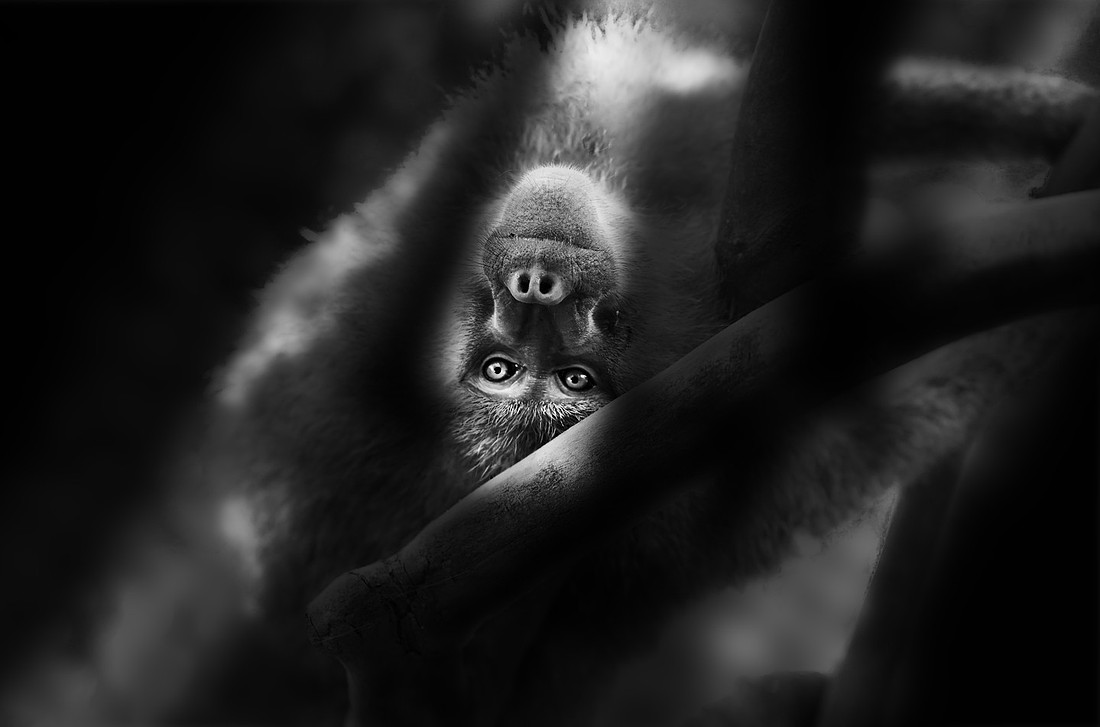

[The Olive Baboon (Papio Anubis)]
|
Each image in 'Studies' is complemented by narrative weaving-in nature and human activity, providing a glimpse of the local ecosystem. It is 'light-touch', gently inviting the audience to investigate further and draw its own conclusion.
During filming, where I have on-scene control, I work hard to shoot from the optimal position within a certain location, with respect to composition and available light - it may require getting low down, getting dirty, in the water ref dragonfly in flight image; it may require me to climb higher up or use a remote shutter trigger ref Nile Crocodile image.
I shoot in colour, looking primarily for lighting conditions that may provide this stronger contrast. For high impact effect the final rendition must have some pure black and some pure white midst the tonal range of greys.
What does this monochrome method do well? This method works beautifully in minimizing distractions, simplifying an image whilst enabling us to focus more readily on the subject. It brings out texture and interestingly, it enables us to shoot in harsh midday sun, that would not work in colour. |
Planning:
There is no doubt, I enjoy more success in terms of usable image files, when I have planned well. ref Big Tusker' project.
Having been to Amboseli twice previously and established reliable contacts, a planned photographic project could take shape more easily.
And when it comes to Tusker elephants, the chances of coming upon them as an opportunist i.e. turning up and seeing what happens, are slim indeed.
The Making of 'Big Tusker'
Aim - At least one strong image of a 'Big Tusker' bull elephant.
Supporting this simple aim, a host of considerations were important in improving our chances of success - an appreciation of the seasons (generally trying to avoid the rains and floods that limit movement) and the least busy tourist period as well as periods during the year when Mt Kilimanjaro summit is more visible.
Travel time was a potential issue in terms of how quickly I could be in Amboseli from Sydney when triggered by Nick, my guide in Amboseli.
And none of this would have been possible without the availability of the network of guides and rangers providing 'eyes and ears' for us on the ground with radio communications, as they went about their other jobs.

[On Location Notes: Amboseli Map - tracking the small group of 'Tuskers']
This time I was there for about five days, but it was the first one I had planned with a specific task in mind, having scrambled from Sydney to Amboseli within 30hrs of being notified by Nick. We twice successfully located the small group of these elephant - the system was working and we were of course, lucky.
This particular image was taken on the last day - we had been mapping the progress of this group of three. Over the week we were working hard at positioning and then more repositioning, trying to create opportunity. Nick managed to get our vehicle well in front of this elephant that was leading the way, with Kilimanjaro behind. The afternoon light was angling in from my left providing dark contrasting shadows, whilst highlighting enough of the subject showing strong texture and form.
We try to minimize our impact on the animals and their environment. We try not to disturb wildlife, as far as possible. To this end we remain passive observers. We do not intentionally aggravate animals, we do not get close to the active nests of birds, we do not bait animals to bring them close to us nor interfere with them to get them to do something for the camera.
Here, the elephant is at ease in his element, hardly noticing our presence.
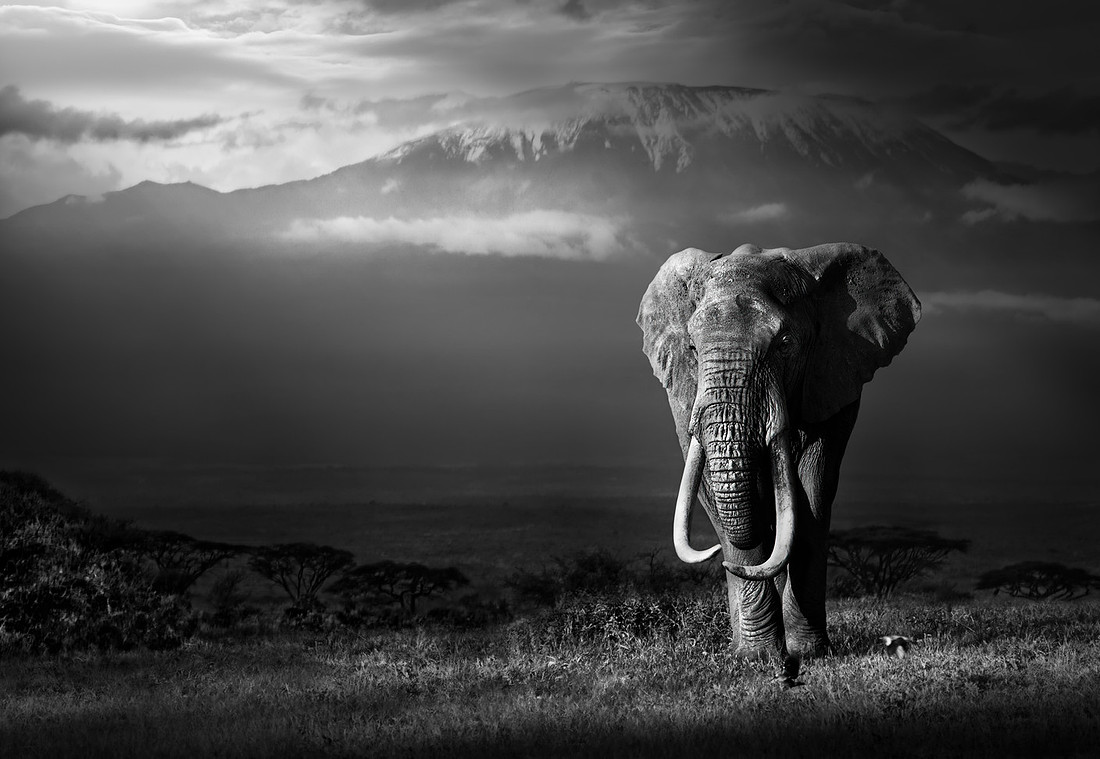
[Big Tusker - Amboseli]
In-Camera:
'Getting it right' in-camera as far as possible is not only challenging but fun - it makes things so much easier when it comes to post-capture processing.
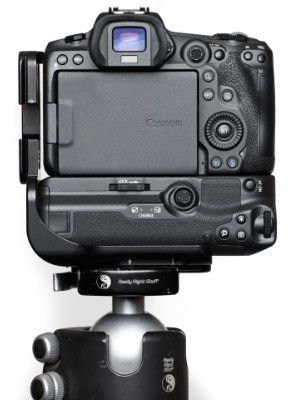
Technically, there is a significant advantage in shifting the autofocus function from the default front 'shutter-release button', to a back-button. So the front 'shutter-release button' only meters the light and releases the shutter and does not control autofocus.
Landscapes and Static Scenes. Shooting in Manual is a huge advantage, embracing the need to constantly read the light and adjust camera exposure setting 'clicks' accordingly - complete control.
Wildlife and Moving Subjects. Here we need to be ready for rapidly changing situations and tracking moving subjects through variable light whilst keeping the recorded exposure of the subject constant. I use Manual with Auto-ISO, operated easily via the back panel with 2 customized 'Exposure-Compensation' buttons.
Further, when using the Canon R5, I not only use 'double back-button autofocus', but tracking and eye-detection controlled via another customized back button. A superb ground-breaking system.
|
Kit - the kit varies, but for landscapes and wildlife I generally choose the following:
|
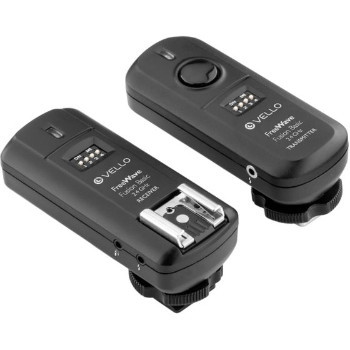
Post-Capture Process
- Enhancements - some RAW files are developed with minimal enhancements whilst others require more thought and significant work, sometimes over prolonged periods.
- Occasionally I use blending techniques to gently enhance the texture of a background, for greater effect (see Grey Crowned Cranes image below). The composite images used in this process are taken from the same area as the primary, and are usually wood, stone, grass or dirt/mud. This method tends to create a nostalgic or aged effect in the final work. It compliments images of species 'vulnerable to extinction', eliciting more of an emotional response in the viewer; they are 'aged', almost gone.
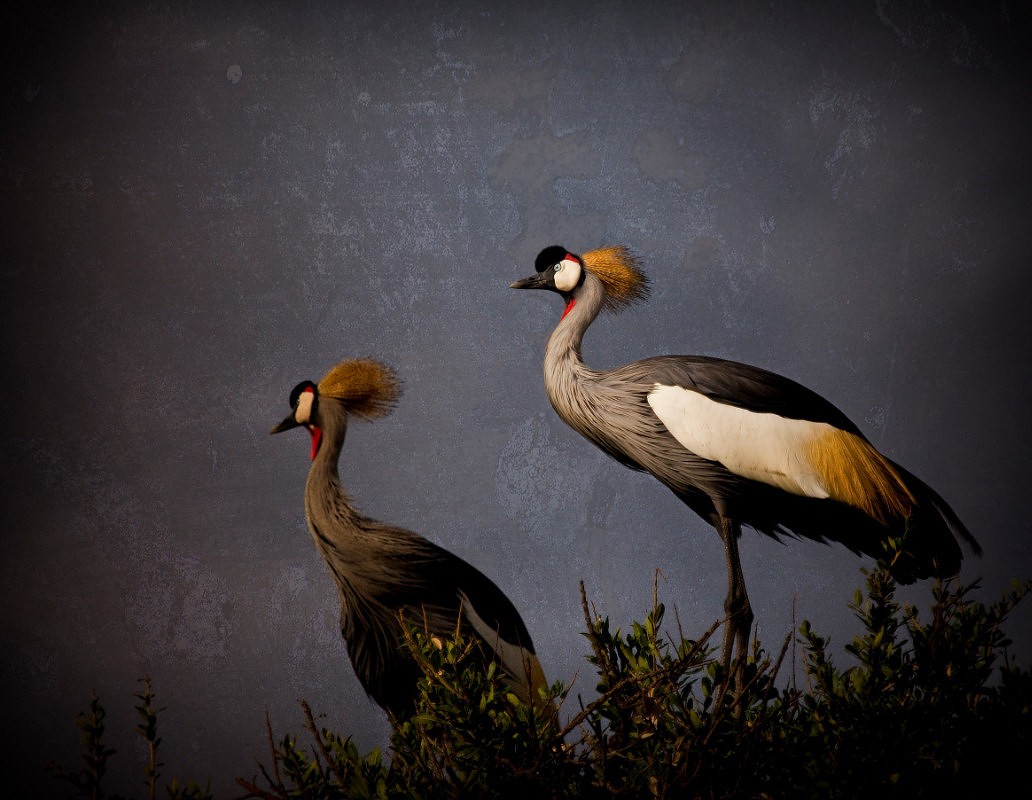
Grey Crowned Cranes Listed on IUCN Red List of Threatened Species as 'Endangered'
Printing Partners:
|
Large print is often described as 'the ultimate expression of a photographic image'.
I am lucky enough to have partners who are consummate professionals in their respective fields - BowHaus based in the LA.
|
|
These guys are an essential element, part of the team and wonderful to work with. I listen to them - each individual print is a project, discussions take place, decisions are made, proofs produced till we are satisfied, before the final large print is slowly rolled out with all the care in the world.