Chobe River
Botswana
IUCN: Listed on IUCN Red List of Threatened Species as 'Least Concern'
Study 1 of 2 - Thriving Birds of the Chobe
Image Story: We are on The Chobe River with
Pangolin Photo Safaris and Danielle Carstens as our 'host', in one of their specialist launches designed specifically for photographers.
The Chobe River is not only beautiful but in these regions it is big - in the lower reaches it is up to 2km wide.
There are numerous islands and parallel channels, all ultimately joining the Zambezi River before plummeting over Victoria Falls.
This place is a stunning paradise for wildlife, particularly birds. Just consider for a moment, our very first outing of this trip!
Over a 2 hour period at one location in Elephant Bay, we witnessed families of elephant taking turns to come down to drink and bathe, a fish-eagle gracing us for about 10 min, bathing and preening about 8m from our boat before flying off, kudu, zebra, baboon fighting, 3 lionesses, crocodiles and not least, skimmers doing their renowned skimming runs over the water.
The routine abord 'The Voyager' mother-craft requires a spritely 0630 departure abord our smaller launch.
Its August and the air is chilly; it's just getting light and the rising sun becomes an orange ball on the horizon as it ushers in the new day.
After a reassuring pre-departure coffee, we are soon moving over the water at about 10 knots towards our first location for the morning.
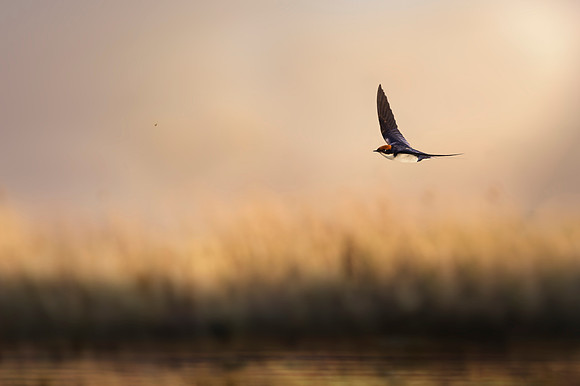
Swallows have a habit of generally following this launch for a good 5 min after departure - we assume they are feeding off small flying insects that take flight from the disturbance on the water.
During this period, whilst underway, I have been working at tracking these small, fast and erratic birds, much to the amusement of my fellow colleagues!
Swallows that are feeding, are notoriously difficult to photograph in flight, especially in low light, from a moving platform.
Today as the light improves I am able to lock onto some of them for short periods.
There is no doubt, even with these fleeting opportunities presenting, the Canon R5 gives me a very significant advantage via its extraordinary auto-focus and eye-detection capability. Coupled with a hefty 20 frames/second on electronic shutter setting, my chance of success looks a little brighter.
Here, the subject may be 'locked on' via AF and eye detection for only a second or two, before the bird jerks out of frame altogether, in a new direction for another 1 or 2 seconds, sometimes longer if I am lucky. I find that if I happen to get the bird back in frame within a second, the AF/eye detection will very quickly lock-on again.
In trying to work out some method to further improve success rate in this scenario, picking up the bird at a distance and trying to track it in as it approaches, I find has limited success - I can lock-on to a subject but not close enough to be of use.
Their unpredictable and erratic movement is dramatically amplified via a long lens as the bird get closer.
Having both eyes open helps to a degree in seeing where the subject has just moved-to but then human reaction time generally keeps the swallow ahead of the game.
BUT doing all this with a good dose of luck gives me a chance.
Sooooo.....a low percentage success rate, and THAT'S with technology and luck on my side!
In this image, the swallow does go for the flying insect in the Left of the frame, but in doing so, subsequent exposures show it banking to its right whilst turning slightly away from the camera......denying me an opportunity to get an image of this swallow with mandibles open about to catch its flying prey. Till next time!
Wire-tailed swallows’ diet consists mainly airborne insects, especially flies. Other insects that they feed on are termites, ants, beetles, butterflies, and moths.
They are commonly seen chasing their insect prey in fast and dramatic aerial pursuits.
Interestingly, they are monogamous and only find a new partner in the event that their current partner dies.
These Wire-tailed Swallow in Africa, lay only 2-4 eggs and build half-bowl nests for their eggs using mud they collect with their beaks.
While other swallow species tend to nest in colonies, these swallows are more solitary and are territorial nesters.
They are thriving here.