Chobe River
Botswana
IUCN: Listed on IUCN Red List of Threatened Species as 'Near Threatened' - The African skimmer is generally uncommon.
Image Story: It's a chilly early morning at about 0600 before sunrise on the banks of The Chobe River.
2 of us are on this drive accompanied by our
Pangolin host and guide. These specially kitted out photographic vehicles are superb.
The air is fresh and still and when we drive down to the banks of the Chobe River, the water is glass-like, presenting spectacular reflections. The sky changes quickly, as the light improves.
We position ourselves on the shore to observe a Yellow-Billed Stalk, stepping carefully through the shallows, jabbing its beak into the water here and there.
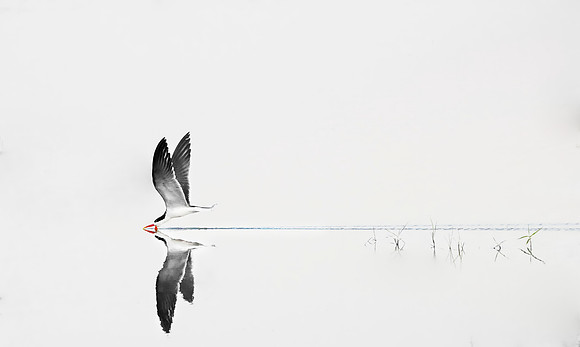
Then as I am concentrating on the stalk and composition, our host shouts 'Skimmers!'. There directly to my left is a lone skimmer in flight, lining up an approach to its feeding run. It provides us with a wonderful long skimming track through the still glassy water before gaining height and flying away.
Technically... These Skimmers tend to fly low and fast albeit in a straight line when on a feeding flight-path. But their shape affords them a 'stealth' low profile, especially head-on, that no doubt increases their feeding success rate.
But as this particular skimmer banks round to its right and into its final approach I can see we will be side-on to its feeding run. Perfect!
I have the positional advantage here when compared to head-on approaches, but the light is low and I will have a high ISO.
With this camera body (R5) and RF lenses, I have a fantastic low light capability and so I can take such opportunities with ISO readings up to about 12500 with some degree of hope, if not confidence in being able to manage noise - with most other professional level cameras (2022) this would not be the case.
1/1800; f5; iso 12500
Furthermore, I have ground-breaking autofocus with eye detection capability that helps me promptly lock onto this bird in flight and hold it for the duration of its run across my front.
It’s the breading season for Skimmers and the time of year they can be found at certain locations on the Chobe flying low over the water in their typical feeding pattern.
These are extraordinary birds.
Their distinguishing characteristic is their bill. Skimmers all have prominent underbites, their lower mandible (lower part of the beak) being noticeably larger and longer than their upper mandible and they are flexible to prevent injury during the skimming action.
They hunt by flying low over the water, and dipping their sharp lower mandible beneath the water as they fly.
When they feel prey hitting the lower mandible in the water, they snatch it up into their mouths, before gaining height and moving away.
The Skimmer species prefer warmer seas, and live in tropical or subtropical regions.
The African Skimmer is found from Senegal to northern Congo River and southern Nile Valley, southern Tanzania to the Zambezi Valley, and then to KwaZulu-Natal Province (South Africa) and Angola.
They live near large tropical rivers with sandbanks for nesting and roosting, lake shores, and coastal lagoons.
Skimmers are primarily piscivores, usually hunting small fish that are easier to scoop into their mouth with their bill. Some of the different fish they eat include menhaden, bluefish, mullet, and killifish. But they also eat squid, shrimp, insects, crabs, and other small marine creatures.
They usually live in flocks providing security in numbers, both outside and inside the breeding season.
However, during the breeding season male and female pairs develop territories, albeit small, around their nests within the breeding colonies and neighbours become hostile towards one another.
Conservation: The population is in decline owing to wetland habitat degradation, over-exploitation and human disturbance.
Humans impact the three species of Skimmers to various extents. The primary threat to all three species, of which all populations are currently declining, is
habitat destruction.
Overfishing, pollution, boat traffic, and invasive species all negatively impact these birds.
Dam-building has flooded some upstream areas and reduced downstream flows, destroying suitable habitat (Urban
et al. 1986, Coppinger
et al. 1988, Ginn
et al. 1989).
Farming practices have also caused siltation of many rivers, raising river levels and swamping breeding islands (Urban
et al. 1986, Ginn
et al. 1989). Egg-collecting, trapping of adults and general disturbance by humans, cattle and recently increased boat traffic can be serious problems in some areas (Britton 1980, Coppinger
et al. 1988, Tyler and Stone 2000).
Disruption by recreational fishermen may impact breeding colonies in the Okavango Panhandle, and local fishermen have been reported using chicks as bait (Vial 1995; cited in Hancock 2008).
Food supplies may have been reduced by pollution, overfishing and introduced predatory fish, but it is unclear whether this has affected its prey of small fry (fish) (Tyler and Stone 2000).
Large-scale spraying of DDT and general water pollution may result in toxic bioaccumulation of pollutants in these piscivores (Coppinger
et al. 1988).
There are no known conservation actions targeted at this species.
Conservation actions proposed include population status and trend monitoring of breeding populations annually and assessing breeding success; conducting public awareness campaigns regarding conservation needs, both through ecotourism to areas such as the Okavango delta, and through local grassroots environmental education (Tyler and Stone 2000).
How can you help? See '
Comment on Conservation'