Okavango Delta
Botswana
IUCN: Listed on IUCN Red List of Threatened Species as 'Near Threatened'
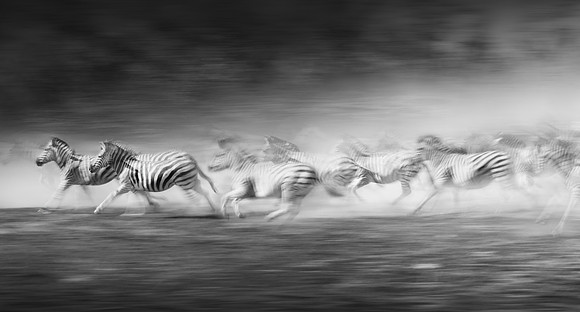
Image Story: A herd of wildebeest and zebra are edgy and alert. These 2 species tend to group, for safety in numbers.
It is mid-morning in August and the weather is largely clear with some intermittent cloud.
Our guide has carefully manoeuvred our vehicle several times. With the sun behind us and to the left, we observe the herd, trying to anticipate which way it will move.
When it does, there is a good chance with so many uneasy animals, that we will witness a stampede. For the moment however, it is mainly static, the animals watching our vehicle, snorting and restless.
We are on one side of a large burnt-out area, with the herd some 80m on the far side. The herd's movement is restricted by a line of thick bush behind, stretching left and right for a few hundred metres.
Then some wildebeest start running to our right and risk taking the herd with them and away from us....that would mean another missed photographic opportunity with the herd running slightly away rather than across our front.
James quickly moves our vehicle to the right trying to catch up and parallel the running animals.....but before we can get in position, they suddenly stop. Hanging on, we turn sharply left to face the herd before stopping abruptly.
The dust wafts past us as we take stock of the situation.
They are no longer looking at us but further to our right and there, 200m away, we see 2 other vehicles, now stationery, that must have just come into view and surprised the herd - the only other 2 vehicles on this concession in this part of the Delta.
The situation for the herd has changed. Now, with the herd's exit to the right effectively cut-off, there is a good chance the animals will turn around and take flight in the opposite direction providing us with a great photo opportunity.
We wait. Everything is still for a few tense moments.
Technically... I am prepared for a panning opportunity with the following setup: double back-button autofocus on the Canon R5, using essentially Manual settings but with quick-adjustment exposure compensation via 2 customized buttons.
This system works very well when you commit to it and can operate the buttons quickly without having to lower the camera and look for them - wildlife photography regularly requires us to deal with unpredictable subjects, movement and rapidly changing light and backgrounds and this is where this system excels.
(Many thanks to
Jaco Beukman and Danielle Carstens and all at Pangolin Photo Safaris).
For panning with these animals, I am on 1/30 sec at f9 which should give me enough depth of field at this range at 500mm. I am reducing exposure by one stop (minus 3 clicks) to prevent burn-out to the white parts of the zebra. I have taken several test shots to verify exposure.
I am ready.
Then, the herd is suddenly spooked and changes direction 180 deg thanks to the presence of our other colleagues in their 2 vehicles.
This time with the herd feeling trapped and more panicky, we witness a full stampede, zebra leading the charge, gathering pace, moving fast from our right to left - the atmosphere is charged! Some of the zebra are striding out at pace at the front, others are following on, kicking and bucking midst the dust and sound of hooves thudding into the ground.
As it turns out, we are perfectly positioned for this rare, stunning display before us. It lasts for about 15 seconds.
There are several species of Zebra - African equids united by their distinctive black-and-white striped coats.
These are Burchell's zebra (
Equus quagga burchellii), a subspecies of plains zebra.
Their stripes come in different patterns, unique to each individual.
Scientists are not sure about the reason for these distinctive stripes, apart from general camouflage.
The patterns may make it difficult for predators to identify a single animal from a running herd and distort distance at dawn and dusk.
Or they may dissuade insects that recognize only large areas of single-coloured fur, or perhaps the stripes act as a kind of natural sunscreen.
Because of their uniqueness, stripes may also help zebras recognize one another.
Human Activity & Conservation: Plains Zebra are not regarded as Endangered by the IUCN, but numbers are declining.
Hunting, habitat loss due to human expansion into their traditional grazing regions and movement corridors and competition with livestock for grazing, is putting pressure on the Zebra especially in the Southern half of their range.
What can you do? See
'Comment on Conservation'