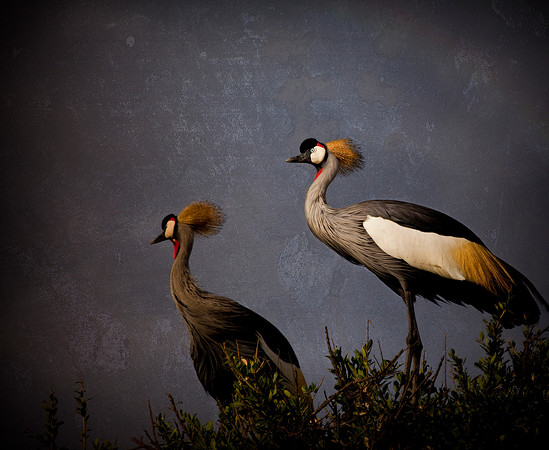
Plains of the Serengeti
Kenya
IUCN: Listed on IUCN Red List of Threatened Species as 'Endangered'
Fine-art Composite Work: The primary image, has background texture incorporated via 4 composite exposures. These 'texture exposures' are of earth, stone and grass, local materials within 100m of the subject.
Image Story: Mid morning, the air is still fresh and clear and my guide Nick and I are waiting and watching a small group of Ostrich.
Then, 2 Gray Crowned Cranes glide down to the 3 thorny acacia trees to our right and settle on their large nest.
Magnificent birds.
They are native to Africa and an Endangered Species. They take their time adjusting things to their liking up there, allowing us to drive closer, with the sun behind us, gracing us with gentle, diffused light for this image.
Crowned cranes are the most ancient of all cranes, predating their relatives by tens of millions of years.
They are monogamous and lay up to 4 eggs in a clutch a year. They have a wingspan up to 2m, weighing up to 3.5kg.
Human Activity & Conservation: Humans are the greatest threat to these birds - poaching and illegal trade (birds used as trophies or pets); breeding grounds contaminated by pesticides, the wild converted to fields for crops, mining operations and direct killing/poisoning of these birds by farmers who need to protect their harvest.
Oliver Nsengimana a vet in Rwanda, is working to save this species, by lobbying Government to ban illegal trade as well as raising awareness.
Oliver's non-profit organisation has enjoyed some significant success reintroducing captured cranes to the wild.
But the global population of cranes is estimated to have declined by 80% over the past 25 years.
How can you help? See
'Comment on Conservation'