The Mara
Kenya
IUCN: Listed on IUCN Red List of Threatened Species as 'Endangered'
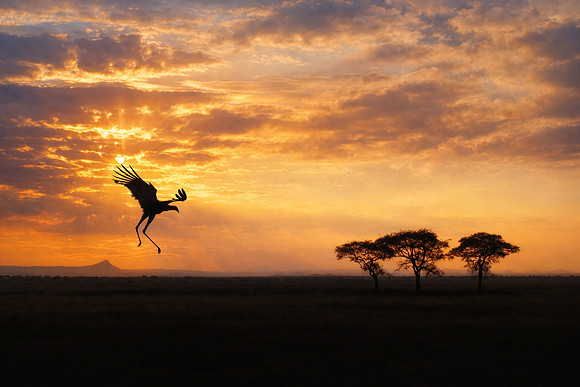
Image Story: It is the end of the rainy season on the Mara plains.
Whilst sudden downpours are never far away, this particular evening, as my guide James and I head back to camp, we are lucky enough to come across the makings of a sunset taking shape through the clouds.
It is not quite a sunset yet, however - to the naked eye, the vista is too bright and desaturated, but I know that on stopping down the available light to the sensor, with filters if necessary, I might see something more interesting in-camera.
I do some test shots eventually stopping down by 2 full stops and here I see the potential - the vibrant colour and detail in the sky with a darker foreground that in turn is losing its detail. But here we have the dimmed sun lining surrounding clouds with silver and gold and bathing the open sky and the much darker landscape below in gentle warm hues.
With the luxury of time to work on the composition, I take about 10 exposures of the slowly changing vista.
Having repositioned the vehicle and adjusted settings again for some further exposures, James alerts me to this secretary bird in flight from left to right, still some distance away.
Their flight pattern is usually slow and predictable and so I still have time - it is worth trying to get this bird in flight.
These are extraordinary birds of prey, and they are not only shy, but vulnerable to extinction. This is potentially a great photo opportunity.
This bird is returning to its nest to roost for the night, usually high up in a large nest in an acacia tree.
Secretary birds differ behaviourally from other birds as they are mainly terrestrial, walking in search of prey.
They find most of their food on the ground - mainly reptiles (with snakes featuring as a favourite) while amphibians, rats and other small mammals are also consumed.
Once a snake has been spotted, the bird will hold it down with its toes and repeatedly stomp on it to stun or kill it.
The bird may then throw it into the air several times before enjoying a well-deserved meal.
Technically... I have setup on Manual, for a landscape with a wide-angle lens at f16 and with remote shutter and camera placed on a sandbag.
Now, I know that to prevent movement blur of the bird, I need a faster shutter speed. And I have about 25 sec before the Secretary bird enters my frame not enough time to change all settings manually for a bird-in-flight.
Key thing - I have saved 3 pre-sets on this camera body - C1 is for a quick setup for birds in-flight and so I can just select C1 and immediately have 1/2500 sec, f9 with auto-iso, continuous drive mode and AI servo (canon) tracking.
This setup with auto-iso will give a well exposed shot of the bird itself if I can lock onto it, albeit with a washed out background.
So I just need to remove the remote shutter cable take the camera off the tripod, select C1 Preset capture 'bird in flight exposures' in good light.
And with luck on my side, the Secretary bird passes just in front of us, gliding slowly down from left to right.
Post capture: I have 2 separate selected images taken about 30 sec apart - a landscape and a bird in flight. This lends itself to a composite image of the two, blending the exposures so they match and ultimately to get a sharper background for the subject.
Human Activity & Conservation: Whilst the decline of the Secretary bird is not in doubt, there is insufficient data to provide accurate metrics at this time (2020).
In 1968 the species became protected under the African Convention on the Conservation of Nature and Natural Resources.
The International Union for the Conservation of Nature (IUCN) listed the Secretary bird in 2016 as a vulnerable species, due to a recent rapid decline across its entire range.
Whilst they are protected in National Parks, proposed initiatives by IUCN include:
Africa-wide monitoring program
Population counts, tracking trends
Where declining, raising awareness among local peoples, esp. livestock herders, monitoring trade of these birds as pets or trophies
How can you help? See '
Comment on Conservation'