Serengeti
Tanzania
Study 5 of 5 - The Serengeti IUCN: Listed on IUCN Red List of Threatened Species as 'Vulnerable'
NOT FOR SALE - Commission (displayed with permission)
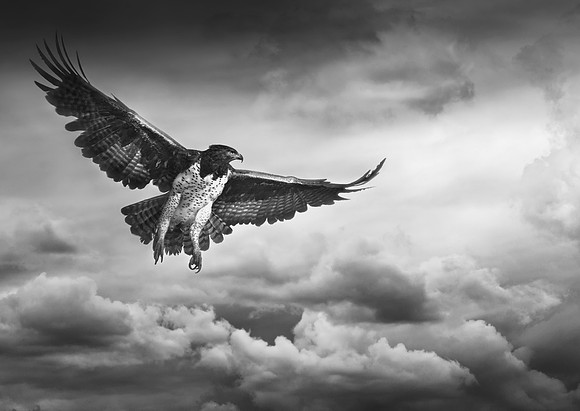
Image Story: The sighting of a Marshal Eagle sparks excitement.
And its not only from we humans, but from many of the prey animals nearby.
They announce the arrival of such a threat with as much noise and agitation as possible, giving warning to others and as a signal to take cover or take flight.
This afternoon in Serengeti, we spot a lone Martial Eagle on top of the tallest tree in the immediate environment.
As we stop, this bird of prey, spreads its wings, taking off with the morning sun highlighting its breast.
A few flaps of those great wings (up to 2.27m tip to tip) and it glides down from the trees over the grassy field and then behind the small hill we are on, into the dead ground and out of view.
This is a spectacular bird; it is Africa's largest eagle with a fearsome and well-deserved reputation as one of the worlds most powerful avian predators.
Native to sub-Saharan Africa, it spends much of its time in flight often at a height that makes it almost invisible to the naked eye.
Martial eagles are renowned for their superior eyesight (3.0–3.6 times human acuity).
They are able to spot potential prey at more than 6km and they have a distinctive attack method, stooping from height, striking with speed, often killing prey on impact, from birds to small antelope.
Nests are built invariably in trees, at any height from 6 to 20 m above ground, but often in the largest tree in the area, and often growing on a steep hillside or in a gorge, where the bird has a clear sweep off the nest.
Male and female form monogamous pairs and mate for life, but they lay only one egg every 2 years - this is part of its conservation issue.
Conservation: This species is threatened by habitat loss, direct persecution, and the impacts of urban development (Bird Life International, 2020).
In the Kruger National Park there has been a 54% population decline in the last 20 years.” says John Davies, project coordinator for Raptor Conservation and Research at the Endangered Wildlife Trust (EWT).
According to Davies. one of the causes for concern is the fact that birds are particularly susceptible to threats like pollution and habitat loss.
The martial eagle is one of the most persecuted bird species in the world.
Due to its habit of taking livestock and regionally valuable game, local farmers and game wardens frequently seek to eliminate the martial eagle.
How can you help? See
'Comment on Conservation'