Serengeti
Kenya
Study - The Serengeti IUCN: Listed on IUCN Red List of Threatened Species as 'Vulnerable'
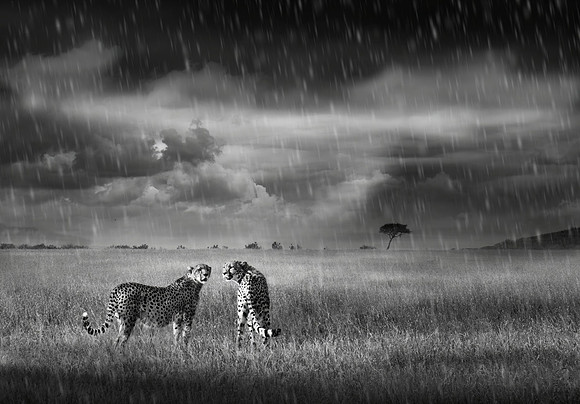
Image story: February in the Serengeti and this late afternoon, the storm clouds are building, looming ominously in the distance.
The sun is low and beams of light reach across the glistening wet grass each side of us.
I am excited by the contrast and how I can possibly use it post capture. I am thinking landscapes, at the very least, looking at composition options.
There is the occasional rumble of thunder, beckoning another deluge of rain.
The temperature is slightly chilly and all is now still.
Typical for this time of year.
Nick my guide catches sight of movement in the grass to the South and turns off, following a small track some 80m till we catch sight of the two cheetah.
There is no-one else about.
One looks as though she is pregnant. And they are are preparing to hunt - both standing, raising their heads high and sniffing the air, as they survey the vast plains for sign of prey - they have unusually good eyesight.
Beautiful animals with stunning features; extraordinary athletes.
It starts to rain again now. And the cheetah, having looked around the general area, both turn to move away again to the South. But before they go, they pause and look back, restless and tails twitching like all cats do. Sun catches the rain falling around us and the cheatah look suitably unimpressed with this wet interruption, ears pressed back.
This is the camera shot.
They head off slinking into the grass, blending ever more into the background till they disappear from our view.
Cheetah can reach 70mph (110kmh) in 3 seconds - the worlds fastest land animal.
They can sustain this speed for about 300m before needing to rest.
The make-up of groups of cheetah vary - they are usually mothers and their young, but there are also groups of siblings after leaving their mother, or groups of males.
Adult females otherwise tend to be solitary animals, getting together with males only to mate.
Conservation: Unfortunately this beautiful animal is threatened by loss of habitat and prey, as well as conflict with humans.
As a result, the cheetah is classified as Vulnerable on the IUCN Red list, and, today, an estimated 9,000-12,000 remain in Africa.
How can you help? See
'Comment on Conservation'