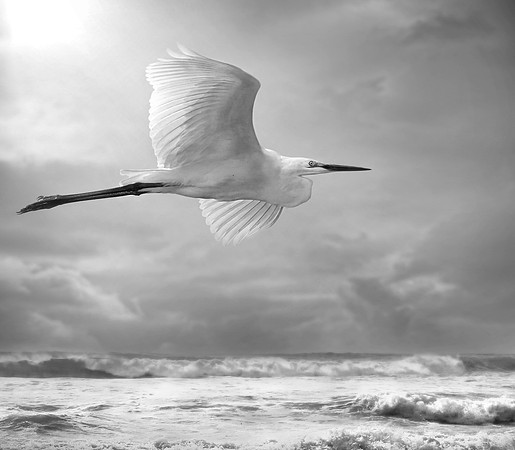
Warriewood Beach, Sydney
Australia
IUCN: Listed on IUCN Red List of Threatened Species as 'Least Concern'
Image Story: Its mid-morning and I have ventured down to the water close to where we live, to witness the aftermath of the some big stormy seas crashing into the Eastern coastline of NSW.
But I am here specifically this day and time, in the hope of capturing images of greater egrets in flight, with a stormy sky and sea as a background. I know the area well.
The violent weather over the past week has abated, the swell and the energy of the sea has mostly eased and the sun is trying to break through here and there.
The air is fresh with an off-shore breeze and birds are about. They are emerging to feed on all the delights dragged up to shore from the deeper ocean - a rare treat for them.
And only 1 Km away, are the Warriewood Wetlands with marshy freshwater, both shallow and deep pools as well as forested areas.
Perfect for the greater egret.
The image I envisage is a back-lit egret in flight with light showing through its feathers, against a background of stormy seas and dark clouds.
Having observed the birds flightpaths - generally up and down the water line where debris has been washed up, I find my spot. The sun when it breaks through, is reasonably high and to my left, the breakers are about 80m away I position myself about 30m from the waters edge.
Plenty of gulls and egrets are about today, flying the pattern.
I spend a few hours here, shifting position occasionally and enjoying the challenge of birds in flight along with changing light and weather conditions.
Technically... I am thinking f16 to be able to capture something of the background for extra mood, shutter at minimum of 1/1500sec to get the large slow bird in sharp focus whilst letting in as much light as possible, and I need to accept a reasonably high ISO in these conditions with some noise potential.
But this mirrorless camera body is industry leader in this area (as at mid 2022) - predictive AF, eye detection and tracking, low light capability.
I am shooting on electronic shutter setting, getting an impressive 20 frames/sec.....and a huge number of images to sort through. But its all worth it.
I am using double back-button autofocus with expanded area AF in a situation like this when a less distracting sky is the likely background; otherwise, manual settings, utilizing exposure compensation adjustments in 1/3 increment clicks, via customized buttons.
This greater egret is fully grown with impressive wingspan. I had plenty of warning as it approached from my left almost 50m away before passing right through my preferred shooting arc, gliding mainly, with some sunlight showing through its large wing feathers.
This is the largest and tallest of the egrets found in Australia, up to 1m tall and living up to 22 years. They enjoy a top recorded speed on the wing of 51kph.
This bird is however, widely distributed throughout the world including North and South Americas, Eurasia and Africa. In Africa, they can be found only outside the breeding season.
Their usual diet consists primarily of fish. But, they can feed upon wide variety of aquatic animals, including frogs and crustaceans.
They will also consume terrestrial species such as rodents and grasshoppers and this diversity of diet no doubt helps the great egret thrive. They feed in shallow water, stepping slowly and deliberately, jabbing their bills into the water to catch their prey.
At sunset, egrets of surrounding areas usually come together, roosting in colonies.
Those living in mild climates, remain in their breeding areas throughout the winter while those, breeding in northern regions where water freezes during the winter, have to migrate to warmer climes.
They are seasonally monogamous, mating once in a mating season and staying with their mates until the end of the season.
Usually, males give a number of displays in order to attract the female. Then they select the territory. The breeding season starts in the middle of April, when the birds construct nests.
They build their nests in wetlands or wooded swamps trying to construct their nests as high as possible for safety and access.
Great egrets' nests are typically unstable platforms, made of stems, sticks and twigs. They rear one brood of chicks a year and both parents take part in the incubation for 23-24 days.
An average egret clutch contains 3 to 4 eggs. After 3 weeks, the chicks start to climb about the nest. Then, after another 3-4 weeks, the young fledge.
Conservation: The Greater Egret is on the IUCN Red List - this species is classified as Least Concern (LC), but populations are decreasing.
In the past, Great egrets were highly threatened due to their feathers, used in the plume fashion trade.
Nowadays, these birds suffer from loss and degradation of their wetland habitat due to invasion of exotic plants, excessive salinity, burning, clearing, drainage and grazing. And the problems are compounded in Madagascar where populations are likely to decrease more rapidly than in other regions because of local people, collecting their eggs and chicks.
How can you help? See '
Comment on Conservation'