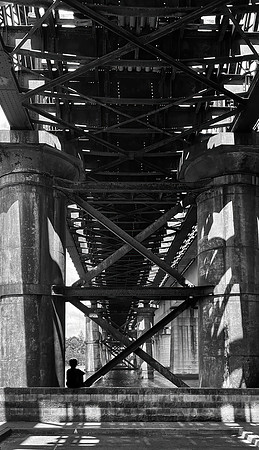
Study - Boy Under The John Whitton Bridge - Parramatta River, Australia
Image Story:
The sensation here is unmistakably industrial. It dominates.
I stand beneath heavy concrete and interlaced metal girders. Broad sandstone piers rise directly from the river, immovable and weathered, carrying the weight of a dense lattice of metal overhead. The structure feels permanent, almost geological — as though it has grown up from the river-bed itself.
At intervals, the stillness is punctured by the high-pitched shrill of a train rushing across above me. The sound arrives suddenly, reverberates through stone and steel, and is gone just as quickly.
Calm returns. What remains are softer sounds: a light breeze threading through the infrastructure, birds calling from the riverbanks, the occasional splash of a fish breaking the surface of the Parramatta River.
I’ve returned to this place many times, drawn by its contrasts. I look for lines and angles, for the play between dark shadow and hard midday light, for the textures of sandstone and ageing metal.
It’s a place that resists easy images and rewards patience.
On this particular day, I did not have my larger camera, but an iPhone. Over the course of two hours, people drifted in and out beneath the bridge. Some paused briefly, gazing across the water. Others sat with their backs to the river, talking quietly.
One boy said goodbye to his two companions. He stayed behind.
He sat still, facing the water, saying nothing — simply watching the river move past.
John Whitton Bridge and the Parramatta River: History, Impact, and Regeneration
The John Whitton Bridge and its predecessor at Meadowbank occupy an important place in Sydney’s industrial, transport, and environmental history.
They reflect not only the expansion of New South Wales’ railway network in the nineteenth century, but also the evolving relationship between infrastructure, waterways, and urban ecology.
Historical Significance
John Whitton, Chief Engineer of the New South Wales Government Railways from 1856 to 1890, was a dominant figure in shaping the state’s rail system.
The original bridge at Meadowbank, completed in the late nineteenth century using wrought iron lattice trusses, embodied British engineering principles of strength, durability, and efficiency.
It was built to carry the Main Northern Railway Line across the Parramatta River, linking Sydney to growing regional and industrial centres to the north.
For more than a century, the bridge supported heavy rail traffic and played a key role in the economic development of Sydney, enabling the movement of people, raw materials, and manufactured goods.
By the late twentieth century, increasing rail demand required a modern structure, leading to the construction of a parallel bridge in 1980.
This newer John Whitton Bridge now carries the main rail load, while the original structure has been retained and adaptively reused as a pedestrian and cycle bridge—preserving its heritage value while giving it renewed civic purpose.
Environmental Context and Impact
The Parramatta River has long been central to human activity, first as a vital resource for the Dharug people, and later as a transport corridor for colonial settlement and industry.
Industrialisation along its banks, particularly in areas such as Rhodes and Homebush, led to extensive ecological degradation during the twentieth century, including heavy metal contamination, altered shorelines, and habitat loss.
The construction of the original bridge inevitably disrupted the riverine environment. Dredging, riverbank modification, and the installation of piers altered water flow, sediment movement, and aquatic habitats.
While these impacts were typical of nineteenth-century engineering practice, they contributed to cumulative environmental stress within an already heavily used waterway.
Over time, industrial activity along the river—not the bridge alone—became the dominant source of pollution, particularly from chemical manufacturing and landfill sites.
The bridge, however, played an indirect role by facilitating industrial growth through improved transport links.
Environmental Management and Mitigation
In recent decades, environmental management around the bridge has focused on minimising ongoing harm and addressing historical contamination.
Maintenance of steel infrastructure over water has required careful control of rust, paint flakes, and legacy lead-based coatings.
Remediation works on the adjacent heritage bridge have included vacuum removal of loose material, containment of debris, and barge-based access systems designed to prevent pollutants entering the river.
These works reflect modern environmental standards that contrast sharply with earlier construction practices.
The repurposing of the original bridge as a non-motorised transport corridor has significantly reduced its environmental footprint. By encouraging walking and cycling, it supports lower-emission mobility and strengthens public engagement with the river environment.
River Regeneration and Ecological Recovery
The bridge now sits within a broader context of river-wide regeneration. Over the past two decades, major efforts have been made to restore ecological function and public access along the Parramatta River.
Projects such as the remediation of former industrial lands at Homebush Bay, the restoration of Haslams Creek wetlands, and the protection of Newington Nature Reserve have improved water quality and re-established estuarine and saltmarsh habitats.
Mangrove regeneration, shoreline stabilisation, and bushcare programs along the river have enhanced biodiversity, while the transformation of former landfill sites into parks and green corridors has reconnected communities with the river.
Recent initiatives, including improved water quality monitoring and the opening of safe urban swimming sites such as Putney Park, reflect growing confidence in the river’s recovery.
A Net Positive Outcome?
While the original bridge undeniably contributed to environmental disturbance during Sydney’s industrial expansion, its long-term story is more balanced.
The adaptive reuse of historic infrastructure, careful environmental management, and extensive river regeneration efforts suggest a trajectory toward net positive outcomes.
The John Whitton Bridge precinct now represents a rare convergence of heritage preservation, sustainable transport, and ecological rehabilitation.
It stands as an example of how cities can acknowledge the environmental costs of their past while actively reshaping infrastructure to support healthier waterways, stronger communities, and a more sustainable urban future.