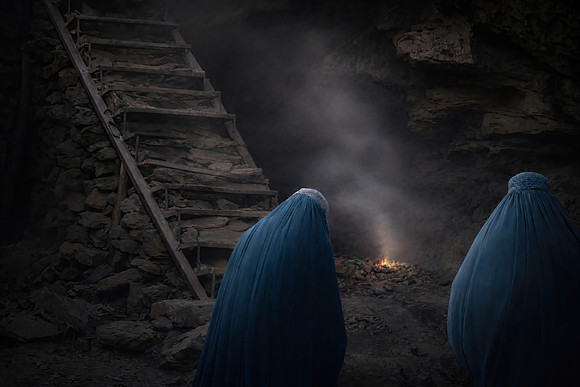
Study - Two Women In Cave
Kandahar
Afghanistan
Image Story:
It is a cold, late December afternoon in the outskirts of Kandahar.
Western foreigners are not expected nor welcome in this region - we are considered the enemy.
We cannot get out the vehicle and we cannot pause for longer than other vehicles around us, for fear of attracting unwanted attention.
At this point, we slow down and pause just long enough for me to capture some images of a scene unfolding to my left.
It has an eery atmospheric feel about it - paradoxically, almost biblical, given we are in the heart of one of the most staunchly Muslim parts of the world.
Light is fading, and amid the cold, dark rocks dusted in grey, two women approach a cave-like entrance that offers a measure of shelter.
Smoke from a small fire curls upward past a ramshackle staircase of stone and wood, briefly catching the last light from above.
Our guide reckons this is where they shelter for the night. There are plenty of scenes like this, telling of a most harsh and pitiful existence.
Technically...
The photographic challenges are significant and multi-fold, including shooting (via camera) through vehicle glass, trying to avoid unwanted reflections and aberrations in the captured image, movement blur and simply limited time to make adjustments to opportunities that are often fleeting.
The trick of course, is to be ready, constantly noticing the light changes and making exposure compensation adjustments with test exposures along the way, so that I am prepared when these opportunities present.
Here, shutter speed must be high enough to minimize movement blur (1/1000).
Aperture is closed just enough to get both subjects in focus in this case (f11 with this wide-angle lens and at this distance) whilst trying to keep ISO and noise to manageable levels.
Filming Limitations:
The security situation is limiting for photography but I just have to adapt and do what I can.
I am supported by a professional and well-drilled operation in Kandahar. We move around in a low profile, deliberately dirty vehicle to reduce the risk of 3rd party awareness.
This outing has been postponed last minute on 2 occasions over the last 2 days.
Now, in preparation, we have been briefed including latest local intelligence 1 hr before we departed, we have personal and vehicle trackers with emergency buttons and a secure direct voice channel to our security ops room; we are all armed and we have a backing vehicle to support or assist as required.
We have one 'safe-house' in-play in the area for this trip. Local routes are always varied where possible and we know what to do when things go wrong.
Having said all that, standing up a small movement operation such as this, is routine for this well-practiced and disciplined group and we are comfortable moving around in this way.
It is when things go wrong and are NOT routine, that preparation, training and experience counts. We experienced no serious issues here.
People:
The people factor plays such an overbearing part when it comes to pressure on the natural environment.
When Governments are poorly run with endemic corruption and when most of the population of a country is desperate for clean water, food and security, then protection of the environment cannot hold sway as a priority.
Almost every facet of life is negatively impacted.
Even when international aid was pouring into the Country during the tenure of the US-supported Afghan Government, the situation for women in Afghanistan for example, particularly in this region, was dire. It improved slightly in other areas, notably Kabul.
But even then, they almost invariably depended wholly on men-folk for their living, having to navigate long term entrenched values, underscoring female subservience.
It was not uncommon to find a woman clad in blue burka, sitting down in the middle of a dusty road busy with vehicle traffic, holding a small baby....in the hope that someone will give her some money for food.
And with the chaotic capitulation of the US commitment there in 2021, ushering in a second term for the Taliban, things are perilously uncertain once again.
It is interesting however, that whilst corruption had pervaded all aspects of society and Government before the Taliban take over, the Taliban on the other hand does not tolerate such vices.
This is a positive aspect of life and work under Taliban rule.
Conservation:
Environmentally, during the Coalition's period of support in Afghanistan, there were some token efforts to address environmental degradation.
But in reality, it probably made little or no difference and it was commonplace to see considerable amounts of discarded plastic along with all kinds of rubbish, in the streets and in the rural areas surrounding Kabul and other cities.
People even then were generally not aware of the need for conservation and protection of the environment - the Country was not yet mature enough and the systems not effective enough to help educate people and change the thinking.
The people after all, both then and now, have immediate and overriding issues day to day in terms of just finding food and simply surviving.
Looking at environmental issues more broadly, Afghanistan’s natural resource base and environment has undergone extensive deterioration over the past three decades as a direct result of wars, political instability and intensive natural resource exploitation - in particular of the country’s meagre forests.
Compounding the whole scenario, recent widespread drought has affected many parts of the country.
The lack of environmental protection combined with a burgeoning human population dependent upon a declining natural resource base has driven many species of plants and animals to the brink of extinction (Environmental Assessment for ADB program 2007).
The situation remains bleak and Afghanistan is considered to be in a state of severe environmental crisis.
The major environmental issues are soil degradation, air and water pollution, deforestation at an alarming rate, overgrazing, desertification, and over population in its already fragile urban areas.
And not least, there are also very limited, unequally distributed, and poorly managed natural freshwater resources.