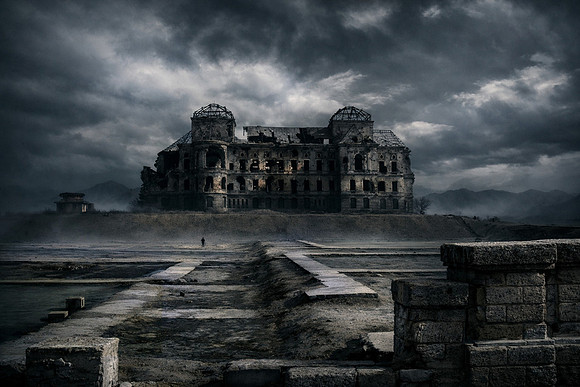
Study - Darul Aman Palace
Kabul
Afghanistan
Image Story:
This is an extraordinary place.
An imposing neoclassical palace that appears more European than Middle Eastern......in the middle of Afghanistan.
It is a cold March afternoon and this vast muddy expanse is deserted but for two men - one walking slowly across the palace forecourt, the other standing closer to it. Both are dwarfed by its sheer size.
The closer man is navigating the wet, muddy area, by walking on top of an extensive array of raised walkways and knocked down walls - all part of once-elaborate palace gardens.
This impressive palace was built in the early 1920s as a part of the endeavours by King Amanullah Khan to modernize Afghanistan.
During the Communist coup of 1978, the building was set on fire. Then, the Soviet war in Afghanistan began as midnight approached on 24 December 1979.
The USSR organized a massive military airlift into Kabul.
Within two days, Soviet forces secured Kabul, deploying a special forces unit against Darul Aman Palace, where all elements of the Afghan army loyal to Hafizullah Amin and Amin himself were killed.
It was damaged again as rival Mujahideen factions fought for control of Kabul during the early 1990s.
Heavy shelling by the Mujahideen after the end of the Soviet invasion left the building a gutted ruin of a by-gone era.
People:
The people factor plays such an overbearing part when it comes to pressure on the natural environment.
When Governments are poorly run with endemic corruption and when most of the population of a country is desperate for clean water, food and security, then protection of the environment cannot hold sway as a priority.
Almost every facet of life is negatively impacted.
Even when international aid was pouring into the Country during the tenure of the US-supported Afghan Government, the situation for most of the population in Afghanistan was dire.
It was common to find a woman clad in blue burka, sitting down in the middle of a dusty road busy with vehicle traffic, holding a small baby....in the hope that someone would give her some money for food.
And with the chaotic capitulation of the US commitment there in 2021, ushering in a second term for the Taliban, things are perilously uncertain once again.
It is interesting however, that whilst corruption had pervaded all aspects of society and Government before the Taliban take over, the Taliban on the other hand does not tolerate such vices. This is one positive aspect of life and work under Taliban rule.
Conservation:
Environmentally, during the Coalition's period of support in Afghanistan, there were some token efforts to address environmental degradation.
But in reality, it probably made little or no difference and it was commonplace to see considerable amounts of discarded plastic along with all kinds of rubbish, in the streets and in the rural areas surrounding Kabul and other cities.
People even then were generally not aware of the need for conservation and protection of the environment - the Country was not yet mature enough and the systems not effective enough to help educate people and change the thinking.
The people after all, both then and now, have immediate and overriding issues day to day in terms of just finding food and simply surviving.
Looking at environmental issues more broadly, Afghanistan’s natural resource base and environment has undergone extensive deterioration over the past three decades as a direct result of wars, political instability and intensive natural resource exploitation - in particular of the country’s meagre forests.
Compounding the whole scenario, recent widespread drought has affected many parts of the country.
The lack of environmental protection combined with a burgeoning human population dependent upon a declining natural resource base has driven many species of plants and animals to the brink of extinction (Environmental Assessment for ADB program 2007).
The situation remains bleak and Afghanistan is considered to be in a state of severe environmental crisis.
The major environmental issues are soil degradation, air and water pollution, deforestation at an alarming rate, overgrazing, desertification, and over population in its already fragile urban areas.
And not least, there are also very limited, unequally distributed, and poorly managed natural freshwater resources.