Greater Kruger National Park
South Africa
IUCN: Listed on IUCN Red List of Threatened Species as 'Vulnerable'
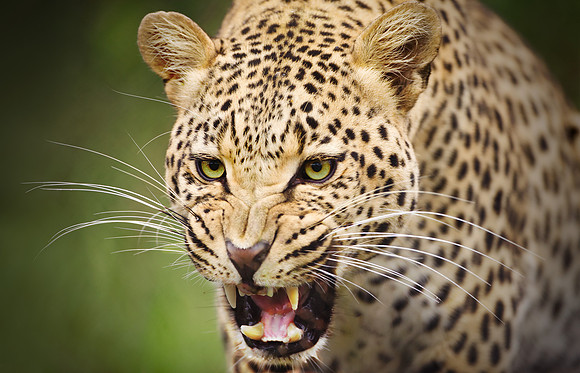
Image Story: Witnessing close up, a large male leopard in his prime - one of those utterly unforgettable and rare experiences!
It is mid-morning in April in the Greater Kruger National Park when my friend and mentor Stu Porter
(Wild4PhotographicSafaris) spots some movement behind a large rock, slight right to our vehicle.
Being solitary and reclusive animals that hunt mainly at night, it is a rare opportunity - this animal is in fine condition as he rises from the crouch to reveal his full stature - solid, muscular with long bristling whiskers and piercing eyes.
He waits just long enough for us to capture a series of images. I have a 500mm lens attached and dare not change the setup with a wide-angle lens, for fear of missing the rare opportunity altogether - they tend not to hang around for long.
And true to form, after a few seconds, with a menacing snarl, he turns and slinks away into the bush. The last we saw of him.
But WOW! What a beauty!
The leopard is so powerful and fast over short distances, it is often the most feared of the big cats, by those humans living in the bush.
Such is its strength, it protects its kill by hauling it up into the trees.
But leopards are not only at home in branches and on the ground; they are strong swimmers, sometimes catching fish to eat.
In fact, the diverse prey on offer for the leopard, from fish to pigs to antelope is probably a significant reason they have survived so far, across Africa and Asia, given lion will seek out and kill leopard.
Female leopards give birth to grey-coloured cubs at any time of year.
During their first 2 years or so the cubs remain with their mother and she moves them constantly to protect them whilst they learn to fend for themselves.
Technically: I have a 500mm lens attached. Manual settings are already adjusted for the gentle diffused light and on closing the aperture from f8 to f11 I have just enough depth of field at this short distance with this lens.
At approximately 10m away, he fills the frame for a moment.
Conservation: African leopards are being forced into ever smaller ranges, primarily because of human activity - roads, farms, industrial developments.
Although the leopard is widely distributed through Africa and Asia, their range has reduced by 31% over approximately 20 years, forcing them into closer proximity and therefore conflict with humans.
In 2 studies in South Africa (Sarbi Sands and KwaZulu), statistics show that over half the leopard deaths are human related.
AWF is currently working with various parties to secure protected corridors that link reserves to each other - the concept is that over time, wildlife including the leopard will be able to move more freely over a larger range, in search of food and reducing the risk of inbreeding.
How can you help? See
'Comment on Conservation'