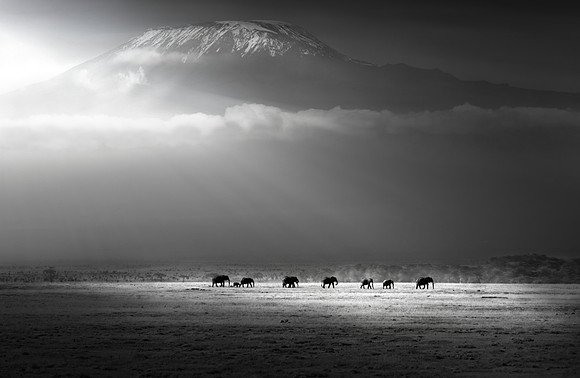
Amboseli Plains below Mt Kilimanjaro
Kenya
IUCN: Listed on IUCN Red List of Threatened Species as 'Endangered'
Image Story: It is mid-morning in May - the end of the rainy season.
Today is beset with unsettled weather from sunshine to thunderstorms.
Short downpours of rain on the warm ground release fresh scent of the bush. Something beautiful and un-mistakenly 'African bush', about it.
Typically, darker clouds are brewing and distant rumbling thunder is starting to resonate about the plains below Kilimanjaro.
We have been watching this family of elephant making its way West to drink, eat, bathe and play in the marshes and small lakes, before they head back to higher ground for the night.
Elephant families stay close together and spend the nights higher up in the foothills of Mt Kilimanjaro - it is safer there for their young.
Each day they trek down to the lush vegetation and water for a few hours at their destination, before making the journey back for the evening - in this case about 4 hours each way.
Now, the sun breaks though the mist and cloud only occasionally, illuminating the ground, before misting up again.
Eventually this group of elephant are lit up by a sunny patch that lasts for a minute or so - the light is diffuse and soft behind them in contrast to the stronger more clear sunlight above the clouds.
This is the moment to try to capture the extraordinary refraction of the sun's rays through the low cloud, whilst it highlights the group of elephant moving below.
Technically... I have the luxury of time in this case. I am using a 400mm lens at f8, 1/500 sec, ISO 1000.
I want to try to get everything in focus front to back as for a landscape setup in a single exposure (without having to do focus and exposure stacking, and a composite rendition).
Aperture is opened to f8 and I want to keep ISO on or below 1000 for this camera body.
By my reckoning, an aperture this wide will work because the subject is so far away from the lens and small in the frame....as long as I can stabilize the camera.
And so, the camera is supported on a sandbag, shutter released remotely and the vehicle engine is off, mirror locked up and Image Stabilization is off.....and the 2 of us in the vehicle are motionless whenever releasing the shutter.
I can take some test exposures to check for exposure (no burnt out areas) and focus at subject, foreground and distant background. If I could not achieve front to back focus I would had to close down the aperture and try again.
Human Activity & Conservation: Currently there are on the average about 100 elephants killed every day in Africa for their ivory.
With an estimated 430,000 African elephant remaining (2019) from an estimated millions during the early 20th century, at this rate the species could disappear from much of their current habitat in 10 years.
Through the 1900's the African elephant was being progressively wiped out primarily from ivory trade and was facing extinction.
The international ivory ban in 1990 provided a temporary reprieve for the species, until 1997 when the ban was lifted in favour of regulated ivory trade.
This resulted in widespread ivory poaching taking hold once again and although in pockets like Amboseli, they appear to thrive, the overall situation is dire and continues to worsen.
What can you do? See
'Comment on Conservation'