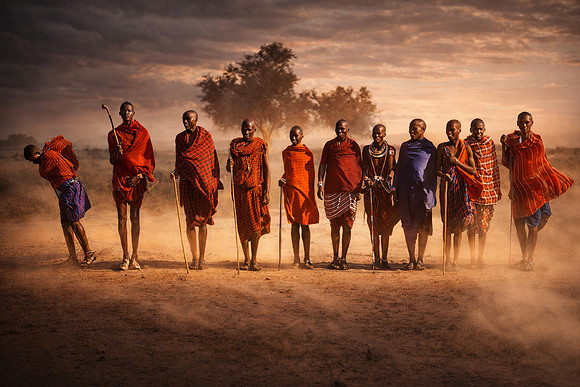
Study - Maasai Welcome
Maasai Mara
Kenya
Image Story:
Maasai Men form up for 'The Welcome' dance.
They choose to live by traditional means, in harmony with the environment, that is now being threatened by climate change and commercial pressure.
Way of life for the Maasai is communal with groups sharing water and pasture.
Their cattle is central to the way they live.
They need cattle for milk and meat and traditionally allow their cattle to graze in one area before moving on to another as nomads, so that the land can recover. Interestingly, they generally do not have more cattle than they need to survive - they are efficient producers, caring for thier environment.
More recently, they have been forced to settle rather than roam and have taken to growing crops out of necessity because of the restrictive pressures on their habitat.
Social structure within groups is based on male age-groups, with males undergoing various initiations from boyhood to warrior to elder.
A Laibon, or spiritual leader rather than a 'chief', sits at the head of each group.
Maasai worship one god who dwells in all things, but may manifest himself as either kindly or destructively. Many Maasai today, however, belong to various Christian churches.
One threat to their way of life is from commercial game hunting, where in some areas, Maasai villages were burnt to the ground to make way for commercial enterprise and game parks.
Whilst the Tanzanian Government has more recently endeavoured to secure concessions for the Maasai, the tribesmen often still find themselves on less desirable land resulting in impoverished groups.
Since 1993 an organisation 'Survival' has assisted several Maasai groups in their struggle for their land. In Kenya they found funds for a programme of consciousness-raising against land sales, and supported the people of Iloodoariak and Mosiro, who are resisting destructive changes to their land.
In Tanzania, Survival has backed the demand of the Maasai of the Ngorongoro Conservation Area for a proper say in its administration, and supported attempts to defend the sacred hill Endoinyo Ormoruwak (‘hill of elders’).
Survival is supporting the Loliondo Maasai’s demand to return to their lands in Loliondo and their call for an independent investigation in to violent evictions.