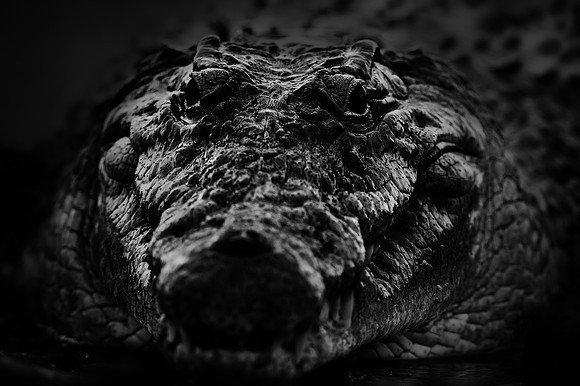
On the banks of lake on Tshukudu
Greater Kruger
South Africa
IUCN: Listed on IUCN Red List of Threatened Species as 'Least Vulnerable'
Image Story: At first, we catch sight of the two crocodiles, a few hundred metres away, swimming towards us.
It is mid afternoon in bright sunlight and we are ready.
This has been carefully planned.
We are deliberately positioned on the shores of the larger of two lakes on Tshukudu. We are a team of 4 with
Stu Porter (Wild4Photographicsafaris) and 2 armed rangers.
The rangers know of a well worn passage the crocodiles take entering and exiting this fresh-water lake.
I have my trusty full frame camera with a short lens, secured in a toughened metal box, hoping to capture close-up images ideally front-on....nose to camera.
With bright overhead light I have an ND filter attached to the lens, reducing available light to sensor by 3 x stops.....all in support of my vision (my hope) for this image with striking tonal contrast from black through to white in an ultimate monochrome rendition.
In anticipation of the crocs moving along their routine track, I have marked in the mud, a line indicating the bottom of the in-focus vertical plane for my ideal focal length about 1m from the front of the lens - all settings on Manual.
At the very least, I need the croc's eyes in sharp focus and I am looking for the dramatic monochrome 'armour effect' of the crocodiles scales.
The shutter release is radio-controlled remotely via the trigger, sitting in my hand, as we wait at a safe 40m from the camera.
The larger of the two crocs leads the way as they glide to the shore and then more awkwardly and slowly make their way along the track.
The first of these ancient menacing looking reptiles moves exactly in line with our camera, pausing before the box, right over the focal plane marker.
This is what we have been waiting for - a fantastic opportunity.
Whether its the box or the continuous firing shutter release noise, causing this croc to pause right on queue, we just dont know. What ever it is, this impressive crocodile is doing me a big favour.
After about a minute, the leader moves on past the camera box and the second one follows just out of frame, to the far side of the main trail.
Its time to move position.
From our second position, we are waiting for the crocs again, this time lying as low as possible on the ground with a long lens.
We trust the ranger to keep 'eyes-on' the crocs all the way and give us location updates till the 2 crocs come into our view again.....and we trust him to let us know if he loses sight of them as well!
This is more straight forward and I am lucky enough to get the second shot I am after, side on to the head, with mouth slightly open so the viewer can just see through the teeth to the other side.
We quietly withdraw back to the 2 vehicles and leave the crocs heading off on their way.
The Nile Crocodile will attack almost anything unfortunate enough to cross its path, including zebras, small hippos, porcupines, birds, and other crocodiles.
It will also scavenge carrion, and can eat up to half its body weight at a feeding.
Firm numbers are sketchy, but estimates are that up to 200 people may die each year in the jaws of a Nile croc
(National Geographic).
Another unusual characteristic of this fearsome predator is its caring nature as a parent.
Where most reptiles lay their eggs and move on, mother and father Nile crocs ferociously guard their nests until the eggs hatch, and they will often roll the eggs gently in their mouths to help hatching offspring emerge
(National Geographic).
Conservation: The Nile Crocodile is designated as lower risk by the IUCN, but are threatened in parts of their range in central and southern Africa where populations have been depleted.
Hunted close to extinction in the 1940s to the 1960s, international protections helped the population rebound in most areas.
But the disappearance of crocodiles from Israel and Algeria may be partially related to climate change and the resulting loss of wetland habitats.
The current status of the Nile Crocodile is that it is relatively secure throughout much of East and Southern Africa, whilst the situation in Central and West Africa is less certain.
In addition, crocodile densities were found to be positively correlated with IUCN protected areas and it is likely that the future status of national populations will be linked to the extent and management of nationally protected habitat (Aust 2009).
Much of the South African crocodile population appears to be at risk from contamination, with large-scale die-offs documented in prominent conservation areas (eg Loskop Dam Nature Reserve and Kruger National Park) since 2005.
Populations in St. Lucia may not be secure, with agriculture, industry (sugarcane) and human settlements in the catchment on the increase
How can we help? See
'Comment on Conservation'