Kruger National Park
South Africa
IUCN: Listed on IUCN Red List of Threatened Species as 'Critically Endangered'
Image Story: This is early morning in the wonderful Greater Kruger. Having got off to a good, even earlier start in the dark, with coffee and 'rusks', Jeremiah my guide and I are now heading towards a well known water-hole.
It is August - the dry season in the Kruger when we have a better chance of sightings around waterholes.
We are hoping for sightings of the big cats....and of course all the other animals that congregate there most mornings at this time of year.
It is a about a 30min drive to the waterhole normally.
This morning, as the sun now rises and its rays prick through the morning mist hanging over the ground, the air is beginning to warm and the animals are emerging.
The breeze is still chilly though and we still have our fleeces on.
This is just the best time of day in this wild world - anticipation and excitement hangs in the air as the inevitable dramas will no doubt play out.
You can smell the bush; it is alive.
Up ahead a large herd of Thompsons Gazelle is straddling the dirt road; they look alert and a little nervous.
We slow down and the herd slowly makes way for us when suddenly to my left there is an eruption of movement, confusion and drama.
Before I can see what is causing it, the gazelle are bursting in all directions - taking flight from an immediate threat.
African Wild Dogs.
Now, its making sense - the alpha-male leading the charge, followed closely by a couple more dogs, are making their move some 50m away from the nearest gazelle.
They are at first running towards us then the chase changes direction suddenly, parallel to the road.
Dont know where the rest of the pack is just yet.
They tend to hunt in a larger pack, in co-ordinated fashion, eventually running down their exhausted prey.
And as much as we value an African Wild Dog sighting, they are notoriously messy and slow killers, taking bites out of their prey, gradually weakening it, then usually eviscerating it - taking out the soft abdomen as the prey eventually dies.
This method is in stark contrast to the efficiency of the big cats that aim to quickly suffocate their prey.
Right now though, the chase is on.
There appear to be about 10-12 dogs that we can see.
For a while, they are all getting away from us and Jeremiah accelerates down the track some 80m.
We spot the chase again - the pack has homed in on one smaller gazelle that has been separated from the herd.
It is running for its life, frantically changing direction trying to throw off the hunters.
At times the pursuing pack is quite close, but then the gazelle seems to find more energy for another burst and it gains some ground.
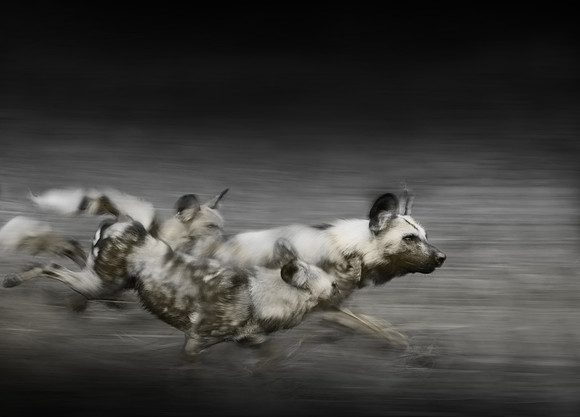
I have been working on panning techniques and I have my pre-sets ready for this very eventuality when opportunity may be fleeting.
As it turns out, I have much more time than I could have hoped for as the chase continues in the general area, twice disappearing from view, away from the track, only to reappear from the scrub and bushes again.
On two occasions the chase passes us a mere 15-20m away providing me with a rare opportunity for panning/action shots at close quarters with a short lens.
I have chosen to process these 2 images (Study 1 and Study 2), giving the feeling of movement, showing this large male at full stretch, full of determination, followed closely by various members of the pack.
The hunt then carries on out of sight, though a few minutes later we catch sight of the pack through the bushes some 50m away, getting stuck into its prey excitedly ripping and tearing, taking chunks of meat away to eat, before going in for more.
For us, its time to pause and reflect on the early morning action, the bush and is cycle of life....and then move on.
Conservation: Sightings of the African Wild Dog are increasingly rare to the extent that the status of a Wild Dog sighting ranks up there with the 'big five'.
They are social animals, living and hunting in packs and found mainly in Southern and Eastern Africa.
Major threats to the survival of wild dogs include killings by humans, viral diseases, habitat loss and competition with larger predators like lions.
Conflicts occur when wild dogs come in contact with people whose livelihoods rest largely on livestock and agriculture and problems arise when expanding human activities decrease the habitat for available prey.
The World Wildlife Fund is doing important work in securing protected zones for the African Wild Dog and raising awareness about this most endangered species.
African Wild Dogs are an IUCN RED LIST critically endangered species. The second most endangered carnivore in Africa. Their population is in a severe decline.
It is estimated that a mere 3,000 remain in the wild -many in small, non-viable, isolated populations.
'Painted Dog Conservation' (
www.painteddogconservation.iinet.net.au) is an organisation committed wholly to saving this species. It provides support to projects in Namibia, Zambia and Zimbabwe.
With a strong commitment to community development and conservation education, this organisation claims to be making some significant gains.
But it relies totally on the generosity of individuals and organisations alike to continue their work.
How can you help? See '
Comment on Conservation'