Greater Kruger National Park
South Africa
IUCN: Listed on IUCN Red List of Threatened Species as 'Near Threatened'
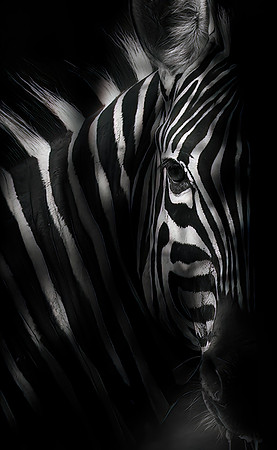
Image Story: We catch a glimpse of her. The evening chill is in the air. From the shadows midst the bushes and trees, a lone female zebra watches us.
She remains there, panting, frothing slightly from her mouth. Ears flicking back and forth, she looks around - alert, on edge.
Tangled vines and branches hanging off tall trees cast deep shadows all about her. She remains partly obscured but at times we can see some fresh wounds to her hind quarters, bleeding all the way down both hind legs.
An all too familiar drama has just played out - we witnessed the aftermath, about 100m away on the left of the track, in the open ground.
A small group of 3 hyena had only just killed a zebra foal and were ferociously tearing it apart - they are messy killers when compared to the big cats, preferring to tear into the soft tissues first, eviscerating their prey usually whilst it is still alive.
Their heads were soaked in blood and they were ripping with a sense of urgency before other competitors arrived.
This mother has just lost her foal and is lucky to escape herself.....for the time being.
It is a harsh reminder of the uncompromising cycle of life that happens every day in these environments.
But right now, she is amongst the shadows with some sunlight filtering down through the branches.
James instinctively switches off the engine, allowing me the opportunity to capture some images without the engine vibrations.
Some moments later she turns and moves off into the vegetation and disappears from view.
That was the last we saw of her.
We will not know if she recovered sufficiently to survive the night, when predators are at large. And they would be able to smell her fresh blood from afar.
We pause for a moment, taking it all in and then we too, move on.
The ground around us highlights one of the principle differences between Kruger with its closer more dense vegetation, and the vast grassed plains of the Serengeti up North.
Here, we often stumble across wildlife at close quarters; in the open ground we get a very different vista of sprawling plains and its wildlife, usually at a distance.
There are several species of Zebra - African equids united by their distinctive black-and-white striped coats.
This is a Burchell's Zebra ( Equus Quagga Burchelli), a subspecies of Plains Zebra.
Their stripes come in different patterns, unique to each individual.
Scientists are not sure about the reason for these distinctive stripes, apart from general camouflage.
The patterns may make it difficult for predators to identify a single animal from a running herd and distort distance at dawn and dusk.
There is a further suggestion that the striped pattern may dissuade insects that recognize only large areas of single-coloured fur, or perhaps the stripes act as a kind of natural sunscreen.
Because of their uniqueness, stripes may also help zebras recognize one another.
Conservation: Plains Zebra numbers are declining.
Hunting and habitat loss due to human expansion into the zebra traditional grazing regions and movement corridors is putting increasing pressure on the zebra.
Competition with livestock for grazing, is compounding the situation, especially in the Southern half of their range - this region, where this image was taken, in South Africa.
The African Wildlife Fund is one of the organisations working with Governments and communities on set aside safe space for wildlife.
The concept is to designate wildlife movement corridors linking otherwise isolated protected areas and in so doing, enabling zebra to range across larger stretches of land.
In this way, they will be able to follow thier natural quest for food and the rains, in turn providing a more healthy balance to the ecosystem.
How can you help? See
'A Comment on Conservation'.