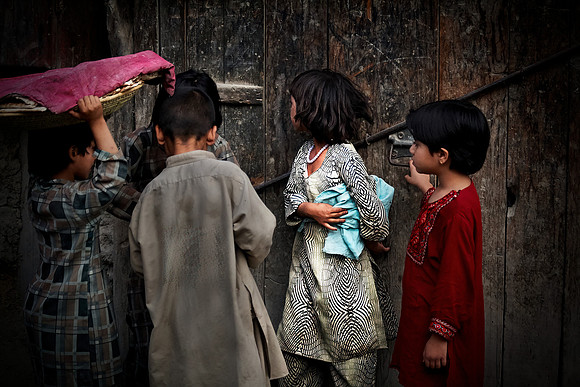
Study - Girl in a White Necklace
Mazar-i-Sharif
Afghanistan
Image Story:
We are driving through Mazar during this mid-morning in April. Bakers are busy baking 'Afghan bread', often in small smoky bunker like workplaces beside the main dirt roads of this town.
The familiar morning smell of wood smoke and warm bread, hangs in the air.
Queues often of children are forming around each of these bakeries. And when the children collect their order, they typically carry the large pieces of flat bread in woven baskets with a cloth covering it, protecting the bread from the dust and dirt.
Midst this particular group, the girl in an unusually clean white dress and necklace, stood out from the others.
Technically:
With the camera I am shooting through glass from a slowly moving vehicle. So I have to keep the shutter high to minimize movement blur. The light is low and the air a little smoky. I have opened the aperture to capture her in slightly better light albeit with a shallow depth of field. But I dont mind the others not being in focus - it helps train the viewers eye on the main subject.
People:
The people factor plays such an overbearing part when it comes to degradation of the natural environment and ultimately the welfare of its own people.
UNICEF reports in 2019, globally there were 19 million internally displaced children from conflict and violence. It will be much higher now.
Afghanistan has a disproportionally high number of displaced children.
When Governments are poorly run with endemic corruption and when most of the population of a country is desperate for clean water, food and security, then protection of the environment cannot hold sway as a priority.
Almost every facet of life is negatively impacted.
Even when international aid was pouring into the Country during the tenure of the US-supported Afghan Government, the situation for women in Afghanistan for example, particularly in this region, was dire. It improved slightly in other areas, notably Kabul.
It was not uncommon to find a woman clad in blue burka, sitting down in the middle of a dusty road busy with vehicle traffic, holding a small baby....in the hope that someone will give her some money for food. And these mothers are generally treated with derision by the rest of the population. Desperate.
And with the chaotic capitulation of the US commitment there in 2021, ushering in a second term for the Taliban, things are perilously uncertain once again, not just for women.
It is notable however, that whilst corruption had pervaded all aspects of society and Government before the Taliban take over, the Taliban on the other hand does not tolerate such vices.
Furthermore, to its credit this Government has declared it is making adjustments and allowing more freedoms for some of its people than previously expected - the world will be watching to note how this plays out.
Conservation:
Environmentally, during the Coalition's period of support in Afghanistan, there were some token efforts to address environmental degradation.
In reality, it probably made little or no difference.
People even then were generally not aware of the need for conservation and protection of the environment - the Country was not yet mature enough and the systems not effective enough to help educate people and change the thinking.
The people after all, both then and now, have immediate and overriding issues day to day in terms of just finding food and simply surviving.
Looking at environmental issues more broadly, Afghanistan’s natural resource base and environment has undergone extensive deterioration over the past four decades as a direct result of wars, political instability and intensive natural resource exploitation - in particular of the country’s meagre forests.
Compounding the whole scenario, recent widespread drought has affected many parts of the country.
The lack of environmental protection combined with a burgeoning human population dependent upon a declining natural resource base has driven many species of plants and animals to the brink of extinction (Environmental Assessment for ADB program 2007).
The situation remains bleek and Afghanistan is considered to be in a state of severe environmental crisis.
The major environmental issues are soil degradation, air and water pollution, deforestation at an alarming rate, overgrazing, desertification, and over population in its already fragile urban areas.
And not least, there are also very limited, unequally distributed, and poorly managed natural freshwater resources.