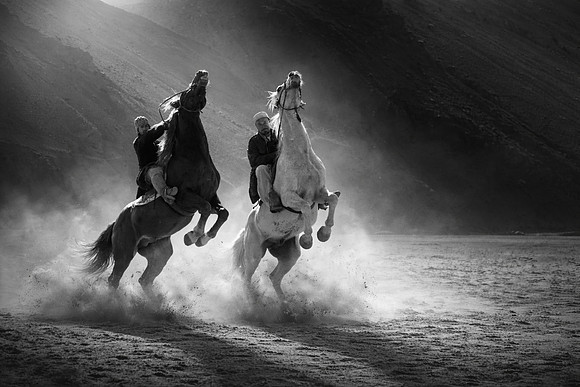
Study - Bushkassi Horsemen
Panjshir Valley
Afghanistan
Image Story:
Bushkassi (various spellings) is an ancient game unique to Afghanistan. There are loose rules and various forms of the game exist, agreed between participants at the time.
Here, these two Panjshiris are playing to the camera - between games they have galloped up to this point before abruptly sliding to a halt in front of me, kicking up gravel and dust before making their horses rare together.
One rider is wearing the headgear taken from a former crew member of a Russian armoured personnel carrier or tank during the Russian's brutal but failed assault on the Panjshir Valley. The Russians suffered thousands of casualties in this place.
There may be 2 teams on horseback to battle it out. A sacrificed sheep's carcass is the 'ball in play' and the idea is to get that carcass over the opponents line to win a 'goal', before the next restart.
Yet, in another version of the game the rules may be that a team has to get a rider carrying the carcass from the start, out and around a tree or pole and back again to the finish. And sometimes there are no teams, just individuals playing each other.
Here, the game can only be played on the valley floor close to the Panjshir River; there are steep, dramatic sides to the valley and there is limited space between.
This morning, the sun eventually rises above the heights of the surrounding mountains providing me with a great opportunity to highlight subjects in good light, against various backgrounds - the history of the place, the mountainous surrounds and the game itself suggest 'drama'.
The Panjshiris are a proud warrior-like people rooted firmly in the bold and beautiful Panjshir Valley.
Unlike the rest of Afghanistan, a the time of this photography, they can claim to never have been fully defeated by the many invaders over the centuries from Alexander the Great to the Russians.
During the Soviet Invasion, the Russian forces reportedly carried out no fewer than 9 assaults on the strategic valley, involving aerial bombardment, gunship assaults, armoured assaults (tanks and armoured personnel carriers) and thousands of troops, pushing through the narrow straights at the end and right up to the higher reaches.
As if bearing witness, there remain many rusting wrecks in the valley of Russian tanks, APC's, helicopter transport and gunships, that had been destroyed during the fighting. There are also plenty of splintered tree trunks and entry/exit signs on long standing trees, from fire-fights in the area.
Each Russian military onslaught was limited by unsuitable and predictable tactics. The invaders would be met by resistance from agile, tactically aware, lightly armed fighters who would withdraw into the side valleys and mountains and attack the Russian forces at will with 'hit and run' raids.
Each time the Russians eventually withdrew their heavy military presence, the Panjshiris would regain control of the Valley.
Ultimately, the Russians withdrew altogether from Afghanistan having suffered significant losses.
Being a reasonably isolated community, with a strong sense of purpose and unity, the Panjshiris nurture the environmental health of the Valley, recognising its importance to their survival - clean river water for drinking and for crops.
This Valley is indeed a beautiful and bountiful paradise when compared to most of the country and they guard it fiercely.