Amboseli
Kenya
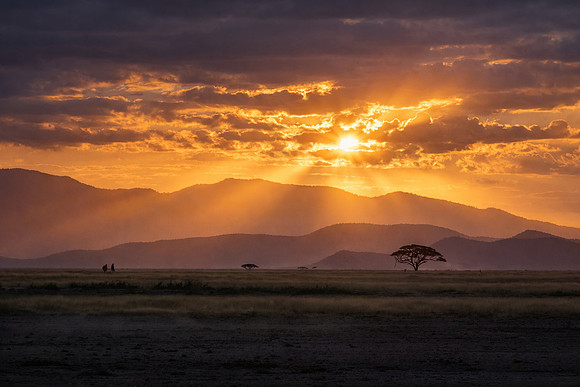
Image Story: One of those moments - after a full afternoon photographing elephant with James my guide, the rain comes in and we start to head slowly back to camp. I am scanning the horizon for landscape possibilities.
Then, there is a break in the weather and the sun peaks through here and there, to the West over the hills in the far distance.
We manoeuvre into a good position and remain static for about 50min in the chilly fresh air, light diminishing further, waiting for the sunset to unfold minute by minute....eventually in a most stunning way.
Technically... To the naked eye, this vista appears in the far distance, a small part of the overall sky.
Through a 400mm lens however, the frame appears evermore dramatic and vivid. We do not have the time to get closer in order to use a wide-angle lens, such is the nature of this rapidly changing sky.
And so, in composing the scene, I have yellow and orange bathed layered hills and some low yellow sunrays piercing the cloud. I can compose this scene with a horizontal land-line at the lower 1/3 of the frame with a prominent lone acacia tree roughly at the lower Right 'rule of thirds intersection'.
With a long lens, I need to be more concerned about movement blur, bearing in mind light is low so I need a slow shutter to be able to manage ISO at reasonable noise levels. With this camera body and lens I am trying to keep ISO at or below 2000.
With 400mm at this distance to subject, I can afford to open the aperture to f4 thankfully whilst still getting the image in focus front to back.
1/80s; f4; iso 2000
With vehicle engine off, DSLR mirror locked-up, remote shutter attached, image-stabilization off and camera supported on the custom sandbags, this was a good as I am going to get it without being able to get out of the vehicle (to use the tripod).
I start taking a series of shots over about 10 minutes, with minor adjustments along the way.
Through the lens I notice 2 Maasai walking slowly towards the hills, slightly Left to Right. Its pure luck that they are discovered here, walking into my frame.
It is a matter of positioning and timing, in trying to get the sunset at its best, with the 2 Maasai in a suitable part of the fame.
What an extraordinary scene!
Conservation: The Amboseli Conservation Program (ACP) began in 1967 when David Western studied the ecology of the Maasai Amboseli National Reserve to address a deep conflict over its status and future.
Today, the ACP continues its four decades of work in Amboseli.
Its main purpose is to sustain the integrity of the Amboseli ecosystem. ACP is also dedicated to applying its findings to the betterment of conservation nationally and internationally, based on the following goals:
- Conduct research on African ecosystems;
- Develop tools for identifying the threats to biodiversity;
- Develop conservation policies and practices that benefit local communities;
- Build local and national consensus and capacity for conservation;
- Promote sound environmental governance and practices; and
- Forge national and international collaboration for conserving biodiversity.
Speaking with the Maasai, our guide and with rangers, they all agree on one thing - there are always multiple challenges that need to be addressed.
And now in 2023 Amboseli is once again challenged by severe conditions:
Severe Conditions in Amboseli - 2023.