Amboseli
Kenya
IUCN: Listed on IUCN Red List of Threatened Species as 'Endangered'
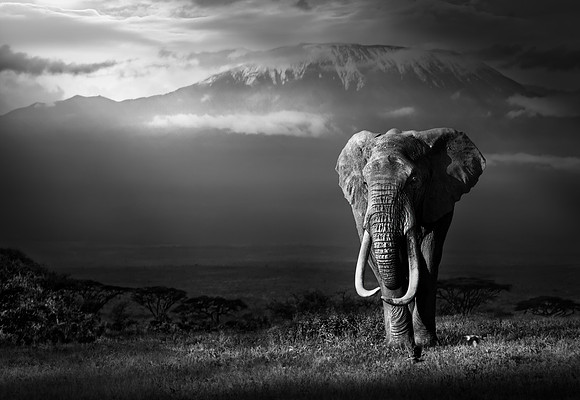
Image Story: Is there anything more impressive? This is a huge bull elephant with enormous tusks, walking slowly towards us with a sense of purpose and air of confidence.
It is late afternoon and when we finally caught sight of him, we had been slowly heading South along Emali Road according to our general plan on this
'BigTusker Project' in Amboseli.
A living force of nature.
And a rare one.
Tuskers are elephants genetically predisposed to growing massive tusks - their tusks carry on growing throughout life, actually accelerating in growth as they get older, rather than slowing down.
We are now static with engine off, waiting and watching.
His presence looms ever larger as he approaches over the brow of a small hill.
I am utterly compelled to watch.
Our ranger network has been searching for and mapping the movements of 3 of these Tusker elephant over a week - these opportunities are rare - not only are we here to bear witness but to capture hopefully at least one quality image, to share with others to highlight the plight of these particular elephant.
Shafts of the late afternoon sun spread across the opening, occasionally highlighting this elephant on his approach.
At 35m away he hardly glances at us as he passes - he seems to be looking above and beyond, perhaps at more important things than the two of us in a static vehicle, tracking his every move.
My guide Nik has been invaluable on this, my fourth visit to Amboseli, doing the leg-work, connecting with the rangers and guides for Tusker sightings.
And in the background, we take into account elephant movement trends during the seasons, volume of tourists pointing us to non-holiday periods, seasonal rain and accessibility by vehicle to the range of these animals.
We do this background work in the hope it improves my chances of a successful outcome.
But ultimately when on the ground in-country, it comes down to just locating these particular elephant(s) first, getting close to them during the morning or evening and then trying to position ourselves so the subject, the backdrop and the light have a chance to work together. Nothing unusual in that!
And as usual, luck plays a very significant part!
People: Estimates (2021) indicate there are approximately 30 of these Tuskers left - they have been hunted and poached for ivory, almost to extinction.
A single tusk from a Super Tusker (where the tusks touch the ground), which could weigh over 50kg, is worth around $25,000 – more once it has been carved
(Tsavotrust.org - 2021). There is some notable good news here too - whilst the Tuskers have suffered almost to extinction, there are a great many (non-Tusker) elephant in Amboseli thanks to protection of these animals by the rangers and counter ivory poaching efforts.
Conservation: Latest statistics indicate there are on the average about 100 elephants killed every day in Africa for their ivory.
During the COVID pandemic, income from the safari tourist trade was almost entirely wiped out and there were and still are fewer rangers employed.
Unfortunately this resulted in a significant increase in ivory poaching again - one of those things that gains momentum very quickly, but to then reverse the trend is difficult and time consuming. It is a long term game.
With an estimated 430,000 African elephant remaining (2019) from an estimated millions during the early 20th century, at this rate the species could disappear from much of their current habitat in 10 years.
Through the 1900's the African elephant was being progressively wiped out primarily from ivory trade and was facing extinction.
The international ivory ban in 1990 provided a temporary reprieve for the species, until 1997 when the ban was lifted in favour of regulated ivory trade.
This resulted in widespread ivory poaching taking hold once again and although in pockets like Amboseli, they appear to thrive, the overall situation is dire and continues to worsen.
What can you do? See
'Comment on Conservation'