Serengeti
Tanzania
IUCN: Listed on IUCN Red List of Threatened Species as 'Vulnerable'
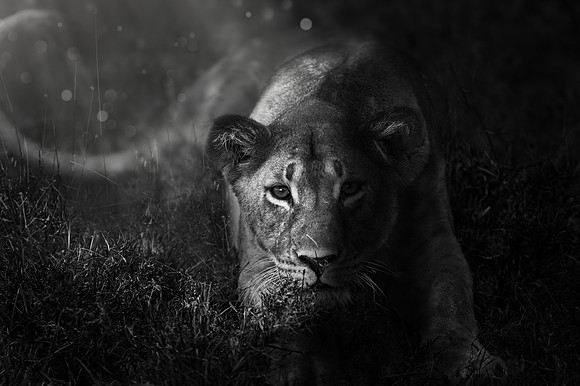
Image Story: This young male is part of an impressively large pride of 22 lion, all in exceptionally good condition - July 2019, during the Great Migration - the land of plenty.
Its late afternoon, the pride is on display in an extraordinary way - it is not the ripping into a fresh kill, nor are the males fighting and nor are they injured and covered in flies.
This evening they are relaxed and content to lie around the green pastures on the banks of tributary of the Grumeti River.
The 8 cubs of varying ages are playing, chasing and rough & tumbling, around the watchful adults - a wonderful and peaceful experience for the time being.
We are the only visitors here and we remain quietly for an hour and a half till the gentle evening light is fading.
The really unusual thing is the size of this pride...and it holds significant conservation importance (below).
Lions do better and survive better when in larger groups, whereas the fragmentation of these groups puts them at greater risk.
Since we are staying in a small temporary bush camp alongside the Great Migration path, we are lucky enough to see this pride one more time before moving on, but this particular evening is memorable.
This image was captured in low light (300mm prime, f5.6, 1/1000, ISO 2000, at ground level)
Conservation: The world's lion population continues to decline.
Lion is classed as a 'Vulnerable Species' as it suffers habitat loss from increased land provision for agriculture
(The Guardian Report ref Agence France Presse 19Jan2020).
Numbers have slumped 43% over the last 2 decades alone, to approximately 20,000
(IUCN).
Lions across most of Africa are threatened.
Rapid decline and the breaking up of larger populations into smaller isolated and more vulnerable ones put the future of Africa’s top predator, at risk.
While lion numbers show positive trends in certain protected areas in Southern Africa, those populations are intensely managed and divided up into many smaller semi-artificial fenced-in reserves.
The thing is, like other large carnivores, the lion needs large and ecologically functioning landscapes for its long-term survival.
The growing demands from increasing human populations, rapidly eat away at those landscapes.
This loss of habitat is the main cause for our recent century’s dramatic decline in lions.
Where lions still co-exist with people, their main threat is persecution resulting from human-lion conflicts.
Lions in Tanzania and in Greater Serengeti Tanzania is one of the most important countries for the lion’s long-term survival.
It has about one third of the world’s lions, and three of the five remaining large extensive populations.
The greater Serengeti hosts one such important population, divided into two sub-populations; the larger Serengeti population, and the smaller and genetically impoverished Ngorongoro Crater population.
Separating these two groups is a multi-use area where wildlife coexists alongside traditional pastoralists and their livestock.
Here the rapidly expanding human population has intensified the human-lion conflict, resulting in low chance of survival for any lion that may travel across, settle in or visit this area.
Today the few lions that persist here, do so mainly as elusive and nomadic individuals.
This has led to an increasing isolation of the Ngorongoro Crater lions.
They now experience a long history of close inbreeding, affecting their fertility and susceptibility to disease.
Without intervention, the long-term survival of the iconic Ngorongoro Crater lion is threatened.
Last September (2019) the Tanzanian government annulled the special status of 12 protected zones and of seven wildlife and forest reserves, allocating more than 700,000 hectares (1.8 million acres) of land to settlement, farming and livestock following an assessment of land disputes
(The Guardian Report ref Agence France Presse 19Jan2020). What can you do?
See 'Comment on Conservation'