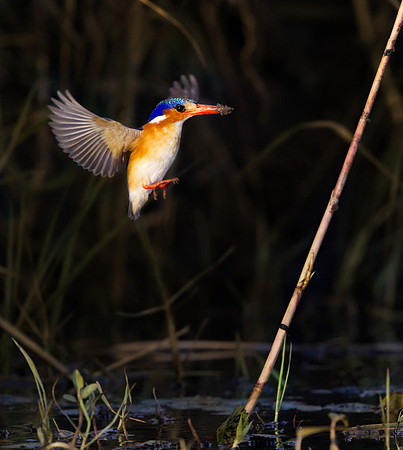
Chobe River
Botswana
IUCN: Listed on IUCN Red List of Threatened Species as 'Least Concern'.
Image Story: We are waiting, crouched yet again, with camera's poised as close to the water level as possible.
Our launch holds its position close to the Chobe riverbank as we wait for this solitary Malachite Kingfisher to take flight. It is tiny - the length of an index finger.
Capturing in-flight images of this small bird is tricky - flight is described as typically rapid, low and momentary.
They dart about the river bank when they are in-flight and exposed, making life difficult for would-be predators (and photographers). And they tend to settle on perches in safe areas in their local domain over expanses of water.
This time of year it is breeding season and much of their non-feeding time is consumed by nest-making.
Whist both male and female work together in building the nest, here over one hour, we see only one bird, not both. And it is busy preparing the nest, deep into the side of the river bank, often a metre or so in from the entrance.
The tunnel usually bends upwards to the nesting chamber. And when the time comes, 3 or 4 clutches of 3 to 6 round white eggs are laid on a bed of fishbones and other disgorged material.
We have been following this bird for about an hour in total, with our coxswain skilfully repositioning our
Pangolin Photo Launch each time the kingfisher changes location.
Eventually it returns to its nesting location. And it is here we have the best opportunity as advised by our 'host'
Danielle Carstens.
Technically… The behavioural pattern of this bird gives us the chance - it settles on an angled perch (seen in this image) for up to 8 seconds before taking off across our front for the 'hole in the wall', into which it disappears to continue prepping its nest.
Then it reappears some 3 to 5 seconds later in-flight straight back to the perch, where it settles and pauses again.
The issue we have in attempting to capture an in-flight image is that there is about a one second window from take-off, to the hole in the mud bank…….and a similarly short window of flight as it appears and returns to the perch.
Not really enough time to respond and have the camera's auto-focus lock-on.
And so on manual focus (fixed on the perch) and slightly closed aperture to f9 to increase depth of field, the technique employed here is to start firing the shutter (at 20 frames/sec on electronic shutter setting) 3 seconds after the kingfisher disappears into the hole….and to continue firing till it is back on the perch/or the cameras buffering takes over!
I am after catch-lights in the eye, wings typically splayed and the late afternoon light and environment gives me the opportunity for a sunlight body against a darker shadowy background.
Human Activity & Conservation: During this trip to Botswana in August 2022, there is much discussion at local level regarding the Government's decision to allow
construction of 11 new Safari Camps ref Africa Press.
Whilst Chobe and the Okavango Delta is still lauded as a largely untouched natural environment with a healthy biodiversity, migration corridors, benefiting from responsible Government eco management, national environmental organisations and local people are now worried.
Accusations focus on high level 'personal interests' holding sway over environmental protection.
Critics of the latest Government initiatives point to the fact that in 2018 (under the previous administration) the Department of Environmental Affairs turned down a proposal for an elephant orphan sanctuary.
It was proposed in the Chobe National Park on account of environmental consideration. It was also under the same administration that the government turned down a request by Botswana’s telecommunications regulator to erect a communications tower, citing environmental concerns.