The Maasai Mara
Kenya
IUCN: Listed on IUCN Red List of Threatened Species as 'Least Concern'
Image Story:
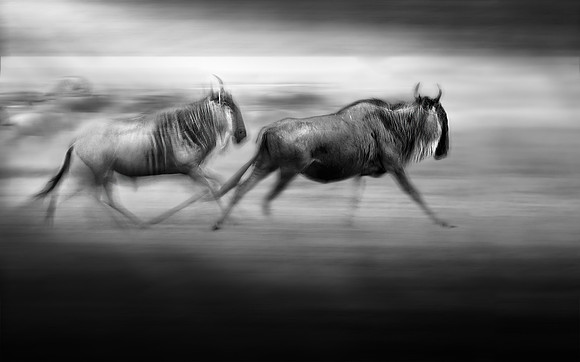
In the noon-day sun, the great herd on the plains is stirring.
Predators are starting to move and the animals are on high alert.
Then, a small group of about ten wildebeest, panic and take off, signalling the start of a larger stampede - a common occurrence.
My guide reacts quickly and is able to get us along this stampede route. He switches off the engine for me and I have about 10 seconds before the action veers off - drama, dust, thundering hooves!
The Great Wildebeest Migration - the annual migration of giant herds of grazers across Northern Tanzania and Kenya is a truly spectacular event.
Over two million wildebeest, zebra and gazelle move through the Serengeti and Maasai Mara ecosystems in search of green pasture, in a regular pattern.
The journey starts in the south of the Serengeti, with the birth of half a million calves between January and March.
The air during these months is full of new life and action.
Predators like lion, leopard, cheetah and hyena are constantly hunting for young prey as thousands of calves are born within a couple weeks of each other.
When the drought comes in May, the herd moves north, to the Maasai Mara, chomping down the high green grass, quickly followed by the gazelle and zebra.
The migration is not without risk: crossing rivers means facing about 3,000 crocodiles, patiently waiting for their opportunity to kill and feed - realistically, almost all of these animals make the crossing successfully without incident.
The Serengeti lion population is by far the largest in Africa.
Then, with the beginning of the short rains in late October, the migration makes its way back into the Serengeti.
By December, the herds trek back to their calving grounds again, and the circuit is complete.
Technically: I am trying to get panning shots of wildebeest on the move - this method highlights movement in a distinctive way - its difficult but when it works it is fantastic.
So here, my settings are ready for panning zebra or wildebeest (that size of animal) and for the current light.
1/26 seconds, f12, iso 300, predictive autofocus AI Servo for horizontally moving subjects, continuous shooting mode.
Human Activity & Conservation: Wildebeest are threatened by the progressive dismantling of their natural environment and the limiting or blocking of their traditional migratory corridors as they search for food.
This results from farming and land development without adequate conservation planning, as well as poaching.
The African Wildlife Foundation is one of the organisations doing some great work, not only highlighting current issues and future problems, but proactively working with Governments agencies and local communities to assist in 'proper planning to ensure a balance between modernization and conservation'.
How can you help? See
'A Comment on Conservation'.