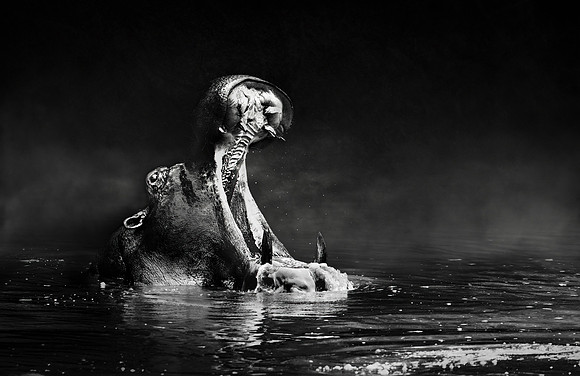
Ubuntu, Serengeti
Tanzania
IUCN: Listed on IUCN Red List of Threatened Species as 'Vulnerable'
Image Story: This is the large dominant male of this group of about fifteen hippos occupying a muddy crescent shaped pool - a tributary of The Mara River in the Serengeti.
Its a show of strength, size of head and mouth and of course....tusks, as he watches us carefully, warning us to stay back.
We need to respect this warning, for these animals are the principle killers of humans in Africa.
The rest are mainly females/cows with some young calves and over the three days based in this location we witness a rather sad story unfolding.
At first siting, one of the mothers has just died - our guide David is not sure how.
The group remains nearby, whilst her calf remains with her, occasionally going right up close and looking at her for long periods.
Soon, the crocodiles start arriving and they begin to attack the soft areas of the carcass, mainly the rectal area.
The calf seems distressed and interestingly, approaches the crocodiles only a few meters from the feeding.
Each day we cross this small river, the mothers carcass is progressively swelling and we can smell it from 50m away.
The crocodiles are making headway, punching into the carcass from under the mother's tail, wriggling and coming away with mouthfuls of flesh......and each day we see the calf watching, approaching the carcass but not getting amongst the gorging crocodiles.
We are not sure what holds in store for the calf from here on.
David thinks it will probably be old enough to survive as long as it sticks with the group.
It seems separate to the main group with its reluctance to leave its dead mother, but we will not know how this story plays out.
Conservation: The International Union for the Conservation of Nature (IUCN) estimates there are only 115,000-130,000 hippos left.
They were once widespread throughout Africa but are now classified by IUCN as Vulnerable (to extinction).
Their number dropped most devastatingly in the Congo where they have been almost entirely wiped out principally from poaching and hunting by humans for food.
Loss of habitat is a major causative factor - hippos need water all year round, not least, to protect their skin.
But they also need grazing areas on land and this food source is disappearing in favour of climate-change desertification.
How can you help? See
'Comment on Conversation'